This is my diary of my trips to Italy during 2008.
February 2008 Driving in Italy — for the first time, and badly.
February 18th 2008 — Naples to Praiano
The plane's late. It touches down at about 10.30 at night. At Capodichino airport I receive the keys of a hired five door Fiat Punto and find my way to the car park. Opening the boot needs input from a group of grinning Italian boys who are admiring the perfectly ordinary-looking car next to it. Having further expanded their grins by trying to get into the passenger seat, I try to come to terms with the gears - as expected, on the wrong side, arranged in an inside-out format. Driving on the right isn't the issue — sitting on the left is the issue. Not too smoothly, I nose out of the car park and drive carefully round the block, searching for the sign to the motorway towards Salerno that I've so often seen from the Sorrento-bound bus. In the dark, everything's unfamiliar. Now I'm making for the centre of Naples, cursing loudly. In a wide elegant square lined with hotels, I'm considering parking and asking for a room in one of them when I spot a sign to the airport. I head that way, in my relief cutting up a lone fellow-driver as I turn left across his path. I get my first good hooting-at. I almost miss it again - a tiny turning on the right, almost an alley-way, signposted to the A3 out of Naples. At twenty-five miles an hour, I leave the city behind.
"Keep always on the right after Pompeii," Connie has said. "Or you'll end up in Salerno." She makes it sound like a fate worse than death. And here I am, at Salerno and by the looks of it on my way past it to somewhere called Giove. I hastily veer into a little turning off the dual carriageway, marked "Centro". I stop to phone Tina. She sounds exhausted but resigned to my stupidity. I have to follow the coast road out of the centre of Salerno. It will take an hour, maybe more. Wrestling with the unfamiliar gears, I follow my nose and the signposts begin to read "Costiera Amalfitana". Out of the other side of Salerno and on to a narrow pitch black road which seems to have been designed by an engineer inspired by a length of coiled string. The sea is on my left and to my right the rocks that have been dynamited aside to make the ledge I'm driving on. Round a steep bend I encounter a parked car to my right. There's a minor impact as my wing mirror clips it. I hear a tinkle as something rolls away into the darkness. Guiltily I drive on up the forty-five degree angle of the hill. (Later I discover that it's the Punto's mirror casing that went - I don't notice for a day because the mirror face is undamaged, only the wiring is exposed and has to be taped up with a polythene bag to keep it dry.) The journey takes me through Cetera, Maiori, Minori, to Amalfi. After Amalfi I start to feel more confident. The road is more familiar, wider, and finite. As I pass through the tunnel at Furore at about 12.30a.m. I feel I'm coming home. I - and the Fiat - have made it to Praiano, both more or less intact…
The plane's late. It touches down at about 10.30 at night. At Capodichino airport I receive the keys of a hired five door Fiat Punto and find my way to the car park. Opening the boot needs input from a group of grinning Italian boys who are admiring the perfectly ordinary-looking car next to it. Having further expanded their grins by trying to get into the passenger seat, I try to come to terms with the gears - as expected, on the wrong side, arranged in an inside-out format. Driving on the right isn't the issue — sitting on the left is the issue. Not too smoothly, I nose out of the car park and drive carefully round the block, searching for the sign to the motorway towards Salerno that I've so often seen from the Sorrento-bound bus. In the dark, everything's unfamiliar. Now I'm making for the centre of Naples, cursing loudly. In a wide elegant square lined with hotels, I'm considering parking and asking for a room in one of them when I spot a sign to the airport. I head that way, in my relief cutting up a lone fellow-driver as I turn left across his path. I get my first good hooting-at. I almost miss it again - a tiny turning on the right, almost an alley-way, signposted to the A3 out of Naples. At twenty-five miles an hour, I leave the city behind.
"Keep always on the right after Pompeii," Connie has said. "Or you'll end up in Salerno." She makes it sound like a fate worse than death. And here I am, at Salerno and by the looks of it on my way past it to somewhere called Giove. I hastily veer into a little turning off the dual carriageway, marked "Centro". I stop to phone Tina. She sounds exhausted but resigned to my stupidity. I have to follow the coast road out of the centre of Salerno. It will take an hour, maybe more. Wrestling with the unfamiliar gears, I follow my nose and the signposts begin to read "Costiera Amalfitana". Out of the other side of Salerno and on to a narrow pitch black road which seems to have been designed by an engineer inspired by a length of coiled string. The sea is on my left and to my right the rocks that have been dynamited aside to make the ledge I'm driving on. Round a steep bend I encounter a parked car to my right. There's a minor impact as my wing mirror clips it. I hear a tinkle as something rolls away into the darkness. Guiltily I drive on up the forty-five degree angle of the hill. (Later I discover that it's the Punto's mirror casing that went - I don't notice for a day because the mirror face is undamaged, only the wiring is exposed and has to be taped up with a polythene bag to keep it dry.) The journey takes me through Cetera, Maiori, Minori, to Amalfi. After Amalfi I start to feel more confident. The road is more familiar, wider, and finite. As I pass through the tunnel at Furore at about 12.30a.m. I feel I'm coming home. I - and the Fiat - have made it to Praiano, both more or less intact…
February 19th 2008 — to Salerno
The day after I take up residence in the apartment near Connie's, she has to go inland to her mother's for two days because her uncle has died suddenly. Hospitably she invites me to go with her, but I say no, I want to go to Paestum and her mother needs Connie's undivided attention. It's a lovely day, cloudless and sunny. I walk down the road to the Continental to see if N is in and to show him my prints. The sea glints as if it's summer, not February. The gate clicks open to my pressure on the bell. Old S is in the courtyard. He greets me with cries of surprise, pleasure and welcome. A, who has had an email from me to say I'm coming to Italy, comes out, his face lighting up. N is out, it seems. "We are going down to the other house". A means La Tranquillitá. "You can come." We set off, old S pottering on ahead. He unhooks a bag of cabbages from a door knob as we pass. At the hotel, A unlocks the side gate where a generator rattles and pulses. We go down narrow stone steps to a yard I've not seen before.
Cages of rabbits blinking at us expectantly. A is taking handfuls of dry food from a sack and filling the hoppers along the front of the two rows of cages. Each cage is just big enough for one large or two or three half-grown animals. A's father is in the darker half of the outhouse. I can hear chickens and see him collecting eggs. Now A shares the cabbages among the rabbits. They eat with satisfied, half-closed eyes, and preen their sleek fur afterwards. The air is full of the deafening roar of the generator, but no smell. The rabbit cages, including the floors, are made of wire mesh and the droppings fall below them, dry and odourless. "For eating?" I mouth to A. The noise prevents normal speaking. He nods. I think about battery farming and cruelty to animals. But these rabbits seem healthy and even happy. They're safe, dry and among their own kind. They're breeding. Even though they have never felt the grass between their toes, are they being ill treated?
I decide they are not. The chickens strut and peck freely in their half of the shed. There's a cockerel with half a dozen hens. They seem to be laying freely. I'm left in charge of old S while A disappears. Or is he left in charge of me? I watch the rabbits, wishing I had my sketchbook to hand. The old man continues to potter for a while, then leads me back up to the road. At the gate, A appears, suddenly angry with his father's querulous questioning. He strides away, back to the house. I follow the old man. He has begun to go down the steep steps towards the cabins. He collects a pair of secateurs and begins clipping the shrubby hedge at the edge of the terrace. I'm not sure what I should do. The sun is warm, the sea calm and blue, the sky luminescent. I sit on a stone bench and doze. I'm totally at peace, as usual at the Continental. The sea's wash on the rocks, the sounds of people working, even the generator, now far above me and muted, the occasional blare of the Sita bus passing by on the narrow road, all the familiar sounds wash over me comfortingly. A is on the terrace above, fixing some electrical installation in the cabins. As I say goodbye he tells me that the weather will be changing soon. The ruins at Paestum are very interesting, but only in good weather. I would do best to go there tomorrow, if I'm going.
This spurs me into a decision. I'll drive to Salerno, back along the coast road again and stay tonight in a hotel there. Then I can drive on and spend Wednesday in Paestum. The sun is going down on a beautiful calm day as I drive off.
In Cetara I pause and take photos of the town and its tower on the headland. The towns on the coast road conform to a pattern: a tunnel to approach the outskirts, a view across an inlet of the Bay of Salerno, to towers on a rocky headland. The town climbing up the hill behind, houses clustered round the mosaic dome of a central church, a piazza in front of the Duomo and the civic buildings. From Amalfi to Maiori, Minori, Cetara, I drive, savouring the clear blue sunset-shaded sky.
The day after I take up residence in the apartment near Connie's, she has to go inland to her mother's for two days because her uncle has died suddenly. Hospitably she invites me to go with her, but I say no, I want to go to Paestum and her mother needs Connie's undivided attention. It's a lovely day, cloudless and sunny. I walk down the road to the Continental to see if N is in and to show him my prints. The sea glints as if it's summer, not February. The gate clicks open to my pressure on the bell. Old S is in the courtyard. He greets me with cries of surprise, pleasure and welcome. A, who has had an email from me to say I'm coming to Italy, comes out, his face lighting up. N is out, it seems. "We are going down to the other house". A means La Tranquillitá. "You can come." We set off, old S pottering on ahead. He unhooks a bag of cabbages from a door knob as we pass. At the hotel, A unlocks the side gate where a generator rattles and pulses. We go down narrow stone steps to a yard I've not seen before.
Cages of rabbits blinking at us expectantly. A is taking handfuls of dry food from a sack and filling the hoppers along the front of the two rows of cages. Each cage is just big enough for one large or two or three half-grown animals. A's father is in the darker half of the outhouse. I can hear chickens and see him collecting eggs. Now A shares the cabbages among the rabbits. They eat with satisfied, half-closed eyes, and preen their sleek fur afterwards. The air is full of the deafening roar of the generator, but no smell. The rabbit cages, including the floors, are made of wire mesh and the droppings fall below them, dry and odourless. "For eating?" I mouth to A. The noise prevents normal speaking. He nods. I think about battery farming and cruelty to animals. But these rabbits seem healthy and even happy. They're safe, dry and among their own kind. They're breeding. Even though they have never felt the grass between their toes, are they being ill treated?
I decide they are not. The chickens strut and peck freely in their half of the shed. There's a cockerel with half a dozen hens. They seem to be laying freely. I'm left in charge of old S while A disappears. Or is he left in charge of me? I watch the rabbits, wishing I had my sketchbook to hand. The old man continues to potter for a while, then leads me back up to the road. At the gate, A appears, suddenly angry with his father's querulous questioning. He strides away, back to the house. I follow the old man. He has begun to go down the steep steps towards the cabins. He collects a pair of secateurs and begins clipping the shrubby hedge at the edge of the terrace. I'm not sure what I should do. The sun is warm, the sea calm and blue, the sky luminescent. I sit on a stone bench and doze. I'm totally at peace, as usual at the Continental. The sea's wash on the rocks, the sounds of people working, even the generator, now far above me and muted, the occasional blare of the Sita bus passing by on the narrow road, all the familiar sounds wash over me comfortingly. A is on the terrace above, fixing some electrical installation in the cabins. As I say goodbye he tells me that the weather will be changing soon. The ruins at Paestum are very interesting, but only in good weather. I would do best to go there tomorrow, if I'm going.
This spurs me into a decision. I'll drive to Salerno, back along the coast road again and stay tonight in a hotel there. Then I can drive on and spend Wednesday in Paestum. The sun is going down on a beautiful calm day as I drive off.
In Cetara I pause and take photos of the town and its tower on the headland. The towns on the coast road conform to a pattern: a tunnel to approach the outskirts, a view across an inlet of the Bay of Salerno, to towers on a rocky headland. The town climbing up the hill behind, houses clustered round the mosaic dome of a central church, a piazza in front of the Duomo and the civic buildings. From Amalfi to Maiori, Minori, Cetara, I drive, savouring the clear blue sunset-shaded sky.
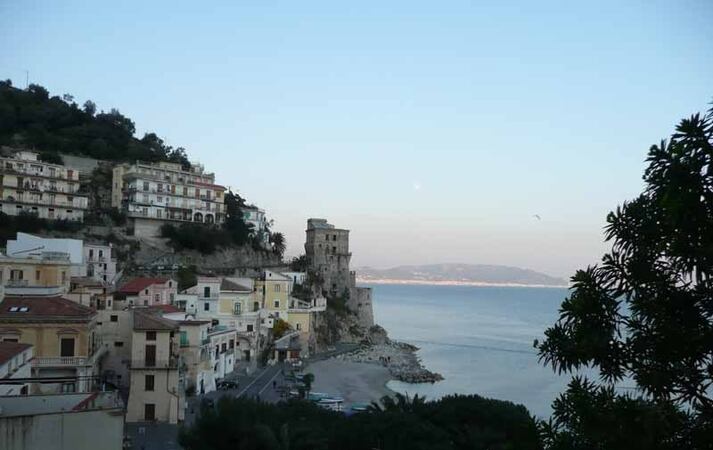
Cetara
At Salerno I take a wrong turning and head a few miles inland, find myself on a toll road and take advice from the attendant, an understanding, twinkling man who has seen more lost tourists than I have had hot pizzas, I think. I end up safely in Salerno and it's getting dark.
Remembering that Connie was concerned that I might not find hotels open beyond Salerno at this time of year, I stop at the first one I see, a large modern block called the Grand Hotel, right on the sea front. It has a wide paved area in front of it, packed with smart cars, with a notice warning all drivers not to park in front of the hotel. There isn't any room to park there, anyway, so I dutifully drive through to a dusty public parking area behind. Too late I spot the underground parking facility. I can't face the manoeuvre to unpark the Punto which I have now snugly positioned between a truck and some scooters. I regret having left my smart skirt behind in Praiano because this looks like a hotel with pretensions. A vast foyer lined with marble lies behind the revolving door at the entrance. The Grand Hotel is inhabited almost exclusively by men in suits, on expense accounts, which may explain the price and the marble halls. It's nice to have a proper shower and a bath - luxuries not available at the apartment in Praiano. I take full advantage of all the facilities before venturing out into the nightlife of Salerno.
I've been surprised to find that the hotel has no wifi. It is disabled, it seems — a situation that I also find in one of the other two hotels I visit in the week. The receptionist has given me a map of the town centre and I walk for 15 minutes or so into the middle of the town, find a public internet point and read my emails. I'm glad to find that even Salerno has its café district where Italians are promenading and sitting, in fur coats and woolly hats, outside in the street. I find a restaurant open but empty and unnecessarily I book a table for later. Then I go for an aperitif in one of the cafes. It's a ritual that I enjoy, watching people and drinking a glass of red wine with bowls of pastries, nuts and slivers of cheese included in the price. I choose Il Castello d'Artiche for this and the nibbles are excellent. I go back and claim my reserved table in the restaurant. There are now three other customers, probably regulars, three men at one table, who look curiously at me as I am seated by the owner at the table next to them. It's a small, homely place with a good menu. I opt for spaghetti with sea food, which is excellent, and a large grilled fish with a mixed salad. I know the fish will be expensive (it's sold by the kilo and that's always expensive and unpredictable in price.) White wine to go with the fish and taramisú after it comes to €42. When I turn down the offer of a complimentary limoncello, the owner offers me a free espresso instead.
By that time the only other customers are a family of three including a grown-up daughter, who are cheerfully celebrating something, I'm not sure of the details - my Italian doesn't extend far enough. It's a pleasant evening. Back through the almost deserted streets, I hurry because I've seen a beggar earlier on, being hustled away from the internet centre where he'd followed me with a wheedling request for money. The girl running the internet centre, a buxom, raw voiced, cheerful young woman, has given the young mendicant no chance to hassle her customers. I don't want to meet him or his like again in the dark deserted street. But like most people in Salerno this chilly night, he's found somewhere out of the wind to shelter in. I hope so, anyway.
Remembering that Connie was concerned that I might not find hotels open beyond Salerno at this time of year, I stop at the first one I see, a large modern block called the Grand Hotel, right on the sea front. It has a wide paved area in front of it, packed with smart cars, with a notice warning all drivers not to park in front of the hotel. There isn't any room to park there, anyway, so I dutifully drive through to a dusty public parking area behind. Too late I spot the underground parking facility. I can't face the manoeuvre to unpark the Punto which I have now snugly positioned between a truck and some scooters. I regret having left my smart skirt behind in Praiano because this looks like a hotel with pretensions. A vast foyer lined with marble lies behind the revolving door at the entrance. The Grand Hotel is inhabited almost exclusively by men in suits, on expense accounts, which may explain the price and the marble halls. It's nice to have a proper shower and a bath - luxuries not available at the apartment in Praiano. I take full advantage of all the facilities before venturing out into the nightlife of Salerno.
I've been surprised to find that the hotel has no wifi. It is disabled, it seems — a situation that I also find in one of the other two hotels I visit in the week. The receptionist has given me a map of the town centre and I walk for 15 minutes or so into the middle of the town, find a public internet point and read my emails. I'm glad to find that even Salerno has its café district where Italians are promenading and sitting, in fur coats and woolly hats, outside in the street. I find a restaurant open but empty and unnecessarily I book a table for later. Then I go for an aperitif in one of the cafes. It's a ritual that I enjoy, watching people and drinking a glass of red wine with bowls of pastries, nuts and slivers of cheese included in the price. I choose Il Castello d'Artiche for this and the nibbles are excellent. I go back and claim my reserved table in the restaurant. There are now three other customers, probably regulars, three men at one table, who look curiously at me as I am seated by the owner at the table next to them. It's a small, homely place with a good menu. I opt for spaghetti with sea food, which is excellent, and a large grilled fish with a mixed salad. I know the fish will be expensive (it's sold by the kilo and that's always expensive and unpredictable in price.) White wine to go with the fish and taramisú after it comes to €42. When I turn down the offer of a complimentary limoncello, the owner offers me a free espresso instead.
By that time the only other customers are a family of three including a grown-up daughter, who are cheerfully celebrating something, I'm not sure of the details - my Italian doesn't extend far enough. It's a pleasant evening. Back through the almost deserted streets, I hurry because I've seen a beggar earlier on, being hustled away from the internet centre where he'd followed me with a wheedling request for money. The girl running the internet centre, a buxom, raw voiced, cheerful young woman, has given the young mendicant no chance to hassle her customers. I don't want to meet him or his like again in the dark deserted street. But like most people in Salerno this chilly night, he's found somewhere out of the wind to shelter in. I hope so, anyway.
20th February 2008 — to Paestum
|
|
Breakfast at the Grand Hotel Salerno is a muted affair. The sun is slanting through the slats of the Venetian blinds and across the gold brocade tablecloths as the men in suits gravely pick out the miniature pots of jam to go with their croissants and bread rolls and pour milk on to their cereal. I have misread the card in the bedroom that relates to breakfast and have already been served coffee there by a kind waitress who explains that breakfast in my room will cost me 20% more than the restaurant menu price, whereas if I go to the dining room it's included in the price of the stay. It's been so long since I've stayed in a hotel with room service, I should have remembered this universal rule. They don't charge me, this time, but I don't get coffee served to me in the dining room as well.
In the car park where the Punto waits, I approach the car with sudden misgivings — at least it's still there. But has anything happened to it? I should have put it into the underground car park. Sure enough, on the bonnet there's an ugly scoring, about two inches wide, paint removed down to the metal, and deeply dented. I'm distraught. Then remember my collision damage waiver and tell myself to be philosophical. (It's only when I look properly at the documentation I signed for the car at the airport, two days ago, that I realise that this is old damage, recorded on the papers, perpetrated by a previous client) Still fluttering from the apparent confirmation of my lack of responsibility in leaving the Punto in jeopardy all night, I gently accelerate and shoot backwards. Screaming quietly, I fumble for the brake and gear lever with both hands flailing. Lucky that the car that was close behind me last night has gone. I stop within inches of disaster. Dare I leave this car park? But I can't afford to spend my holiday in the Grand Hotel Salerno, so I pull my shoulders back, breathe deeply and tell myself that I am not really a waste of space in a car and I can do this. I circle the one way system a couple of times and get on to the coast road again.
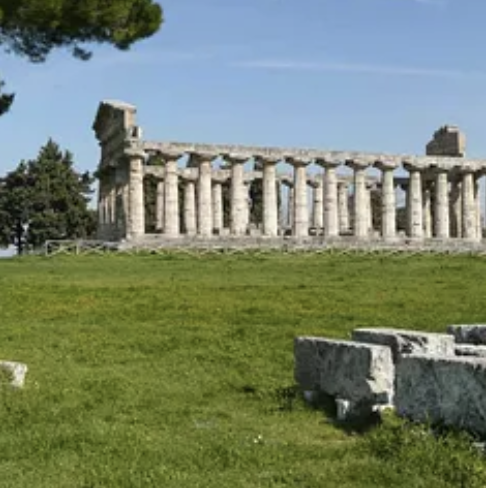
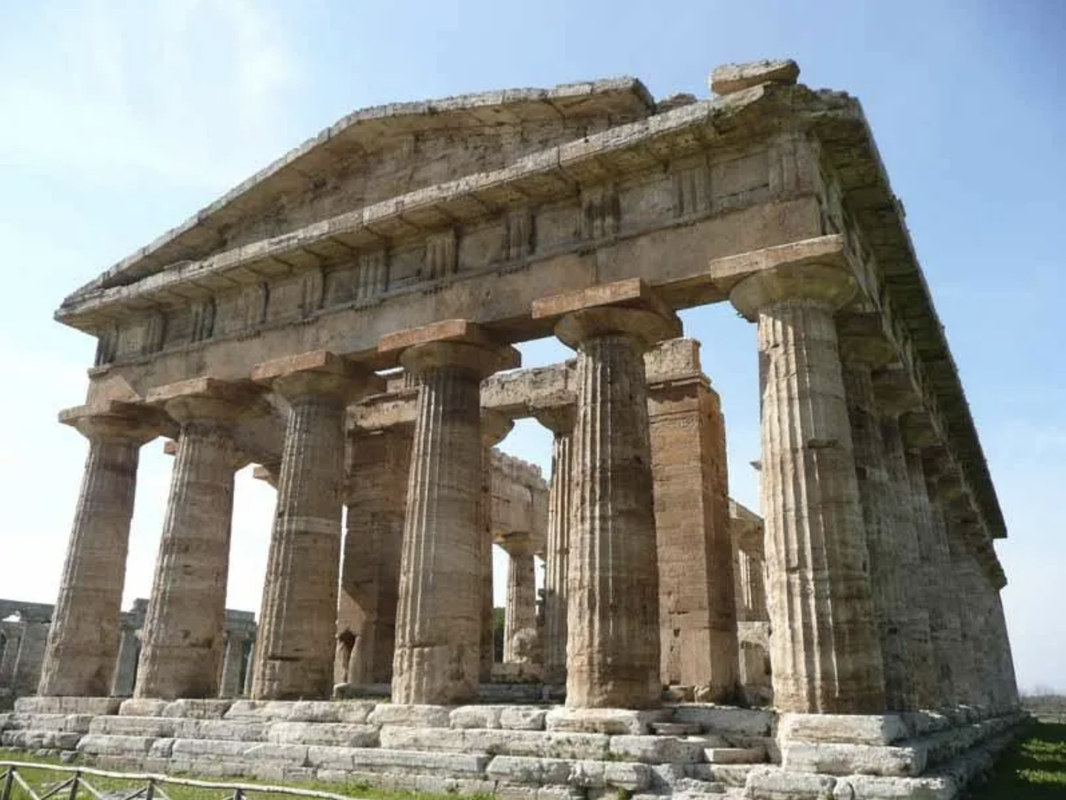
"Just keep on going, with the sea to your right," Connie's advice was simple and it's effective. It's a long, dull, flat drive between pine forests edging the coast and a succession of tawdry motels and "resorts", all closed up for the winter, but at last the brown tourist signs are offering "Paestum" with a picture of a Roman arch. I miss the direct route to the town and drive round three sides of the city wall to an empty car park which costs nothing this time of year because no-one is manning it. As I walk towards the entrance gate to the Graeco-Roman city I get a fine view of the two huge Greek temples at the seaward end of the settlement. In the distance there's another, near the ticket office. In between, low ruins of foundations, huge fallen dressed stones and pillars and a few tourists picking their way through the pathways among them. It's early and few people are about. At the ticket office I have the usual gratifying conversation about my age as I try for a pensioner's reduction, forgetting that pensioners start at 65 in Italy so I have three years to wait. The smart young woman in the ticket office says all the right things about how young I look and I have to pay full price — good value — 8 euros for a ticket that lets me into the ancient city and also its museum.
The sun is high now. People are taking off their padded jackets, hats and scarves, to wander round the ruins and read information about the buildings whose remnants still stand. The three huge temples have been restored to some extent, I gather, but there has been much less restoration than in Pompeii or Herculaneum. I come across a fenced off area where men with wheelbarrows and trowels are excavating the foundations of a house. As I pause to watch, one of them finds something in the dry soil, dusts it carefully and slips it into a polythene bag. Absurdly I feel privileged to have witnessed a sliver of the past brought into the daylight after who knows how many hundreds of decades. "Posso?" I wave my camera at the excavating men and they straighten up and grin. "E molto interessante!" I gush. "Si, si, lui é molto interessante, forse!" laughs the older one, pointing to the younger man. He smiles and is it my imagination or does he preen and pose a little? "No, no, tutti! Tutto é interessante! Il lavoro!" I point the camera, snap the picture. "Buon' lavoro, ciao" and I go on down the dusty path. I wonder how many artefacts lie in layers under my feet.
Paestum's a huge site, a town, with a forum, a little theatre and these enormous temples which must have dominated the whole area, I'd have thought, even when the houses and shops were still standing around them. As I walk up to the seaward end of the site, where the oldest temples lie, the scale of the pillars becomes so impressive that I feel I have to do something other than take photos, even though photos are the most easy and accurate way of recording them. I perch on a fallen stone at a short distance from the Temples of Neptune and Hera and draw. I only have a small sketchbook with me and the image soon becomes so large that I can only fit four and a half pillars on the page.
I become interested in the worn stone details that have survived the 2,600 years since Paestum was founded by the Greeks, their weathered grooves and elegant Doric capitals outlined against the blue sky that has not yet begun to cloud over. Very few other people are around and I don't find the usual obliging Japanese tourist to take a photo of me in front of this ancient structure to show the scale of it. I set my camera on self-time, perch it on the rock where I've been sitting, and rush over to the boundary fence of the temple of Hera. I try not to look too much out of breath and lean nonchalantly on the wooden strut of the fence. Passers by glance up at me but I'm out of reach of curious art critics and happily work there for two hours. The sun begins to fade behind drifting clouds that foretell tomorrow's change in the weather. Most other people seem to be strolling with their partners, except for an English family with a couple of precocious pre-teen children. The adults mutter to each other disapprovingly as they look up at me ("what would happen if everybody sat on these historic stones?"). But their attention is mainly on airing their knowledge of the technical terms of Graeco-Roman architecture as they field and encourage searching questions on archaeological themes from the children. I used to know the parts of a Greek temple, when I was their children's age, but my patience with fact has worn thin over the years. I don't retain the details, just my awe in the face of the age and scale of these stones, the ritual and pageantry they've been used for, and the generations that have revered, assaulted, depended upon and finally neglected them.
There's a very good web page on Paestum's history, with photos that are very like my own, and I'm posting its address here for you to look up, rather than plagiarising the work done by its compiler: http://www.paestum.de/en/paestum.html On that page there is also a photo of the Church of SS Annunziata, an elegant peeling little baroque façade next to the pizza house where I go to fill a sudden void that opens up in my stomach when I finish drawing.
I'm suddenly very hungry. It's three o'clock and Italians are either eating or resting if at all possible. The tables are empty except for a lady of about my age who is immersed in her book. I'm brought a menu and I'm taken aback by the range of pizza toppings and the relatively low prices. I'm used to Amalfi Coast prices. This eatery, in this tourist trap, provides a real pizza - not one of those cellophane wrapped, microwaved efforts that I've met in similar locations before. I eat well. I can't have wine, to my regret, because soon I'll be back on the road to Praiano. A school trip of Italian teenagers makes a bid to take over all the remaining seats outside the pizzeria, chattering and laughing and teasing each other. Some of them are instantly aware that I'm not Italian and they start to greet me in English: "How do you do? How are you? Are you American? Are you English? Are you Aussi? Where do you come from?" I'm tired and suddenly feel very English. My Italian language deserts me. I want to eat my pizza in peace. Luckily, the group decide it's too cold to sit outside and they all surge away, calling back chummily, "Goodbye" and "Have a nice day". I respond with "Ciao, á rivederci" and thankfully watch them chatter out of sight like a flock of exotic starlings.
Before I leave, I want to use the other part of my 8 euro ticket and I cross the little piazza to the museum. I'm glad I did. Inside it's bright, modern and well labelled in Italian. This is a surprise and so different from the archaeological museum I visited in Naples in 2004 . There the mosaics and important finds from Pompeii and Herculaneum were displayed on the fourth floor with no signs to point the tourist towards finding them easily. I find my reading of Italian is good enough for me to decipher most of the information in the museum here at Paestum and there are some labels in English too. The pots in the museum are beautiful, sensual, bellied shapes decorated with pictures of figures of idealised beauty and ugliness, in terracotta, white and black. There are cycles of carvings from the peristyles of the temples and paintings and reliefs and paintings on whole tombs taken from the site. Statues and figurines are
there, of all the periods of long history of Paestum, smiling their bland archaic smiles. I spend a relaxed three quarters of an hour browsing in the museum. I buy the guide book in English, and wish I had the energy left to make some direct drawings of the items in the cases. But it's getting late and I want to drive
back to Praiano in the light.
I get back to Connie's at about 6pm. We're both very tired. Connie's has driven further than me, and she has had a much more stressful two days with her grieving relatives. She tells me about it over supper. When I go into my apartment to get ready for bed, I'm aware of a strong smell - drains are blocked somewhere. I don't want to keep Connie up late, but she comes in and agrees that the problem is sewage based. Not much we can do tonight, though, so I put on my thick woolly socks, open the window and try to sleep.
February 21st 2008 — to Perugia
The rain on the balcony wakes me up at intervals in the night. Getting back to sleep is difficult because of the smell of drains that's wafting through the apartment. It's cold with the window open. At seven I give up the idea of more sleep. It's very grey outside when I open the shutters. The heavy rain's subdued to a thin drizzle on the cold wind. A was right — I've done the best thing, going to Paestum while the sky was blue. But what can can I do on this grim grey morning? The smell is overpowering and that's the deciding factor. (I've been a little spoilt by the splendours of the Grand Hotel, too, I must concede.) I dress and go and see Connie.
"I've decided to use the car today, go and see a bit more of Italy, maybe stay over somewhere. I hope you don't mind," — I feel a bit disloyal — "but the weather is so bad and I only have six days here…" Connie shows what a good friend she is. "I was quite surprised when you came back here last night — I thought you might've gone on, seen some more of Calabria. Of course I don't mind. It's your holiday."
This time I pack my smart skirt to take with me. I look on the map and wonder how far north I can get in a day. Connie and I have looked at the TV weather forecast over breakfast and it's sunny in Florence. But first I must see N, at the Continental. He asked me to bring some prints of my paintings to hang in the cabins. I put my bag in the car and walk down the road in the drizzle. The men who are always fixing engines in the workshop opposite the Continental no longer stare curiously as I come down the hill and cross the road to ring the bell. The gate clicks open after a pause and I go down the steps to the little courtyard. A is there, dressed to go out. N appears after a moment, in working clothes. He greets me warmly and makes us coffee. He politely admires the prints and buys three. I'm surprised by the one he admires most - the beach scene. "That's A's girlfriend," I joke, pointing to the figure in a black bikini in the foreground. I explain that I'm going to drive north today, maybe to Florence, maybe stopping at Perugia, which I've heard is an interesting mediaeval town. "See you in May," calls N as I start back up the hill where the Punto is parked. I'm expecting to come back before I go home this time and tell him so, but in the end that's my last sight of the two brothers before my next trip.
The road to Perugia is not quite direct. I've decided to go there because I've been to Florence before, in another life, and because Perugia is smaller and less daunting to arrive in without a hotel booked in advance, I think. The first hour is spent getting to Naples on the A3. I take a wrong turning off the coast road at one point and find myself in the dockland district of Castellamare, driving up a one-way lane that turns out to be blocked without warning at the other end. At least ten cars have followed me. I get out and wave my arms about, looking foreign, female and foolish.
"Cosa fare?" I call to the men behind who are tuning up their hooters. "Sono inghlese!" An understanding, calm young man comes to the rescue, gets out of his car and moves the barrier out of the way. Led by me, we all do a U turn up the other lane of the road, in the direction we came from, and I'm back on track. The dual carriageway broadens out after Naples and I join the Florence-Salerno road. This is easy, I'm thinking. I stop at a service station twice for petrol and a panino. I know I have to strike out inland sometime after Rome.
The old saying "all roads lead to Rome" has never seemed more true. Rome seems to go on for ever - turning after turning is presented. I'm quite scared of finding myself in the centre of Rome and I keep going. In the event I do turn off too early and I'm on the way to Aquila when I realise it. I stop at a service station and ask advice as well as filling up. Most of the petrol stations are manned rather than self service. My poor bashed Punto attracts sad shakes of the head from the middle-aged men who fill the tank. I feel embarrassed and guilty, as though I've harmed a vulnerable creature. On their advice, I turn round at the next toll station and soon I'm back on the right road.
The last part of the journey seems interminable but at last I see Perugia's hilltop. The sun is going down. It's taken me seven hours to drive from the Amalfi Coast to Perugia. I follow signposts pointing to hotels and I'm led down into a dank dip between hills within the town. I take one look, turn round and retrace my steps - I'm tired but this is not the spot for me. I've seen another sign, to "La Perusia Ristorante & Villa" and that's where I make my stop. It's a good choice.
I book in and I'm apologetically charged two thirds of the room rate of the Grand Hotel Salerno by a charming young male receptionist. The receptionists get younger as one grows older, I'm finding. (I suppose that also goes for policemen, ticket collectors, traffic wardens and really just about anybody with a job.) He hands over the key to a double executive room, which he explains is normally much more expensive but it's a very quiet time of year for the hotel. I make myself thoroughly at home in this big comfortable room. In particular I make full use of the huge bath in the ensuite bathroom . Then I go across the courtyard to the restaurant. I'm too tired to go exploring Perugia tonight and I'm hungry.
In the car park where the Punto waits, I approach the car with sudden misgivings — at least it's still there. But has anything happened to it? I should have put it into the underground car park. Sure enough, on the bonnet there's an ugly scoring, about two inches wide, paint removed down to the metal, and deeply dented. I'm distraught. Then remember my collision damage waiver and tell myself to be philosophical. (It's only when I look properly at the documentation I signed for the car at the airport, two days ago, that I realise that this is old damage, recorded on the papers, perpetrated by a previous client) Still fluttering from the apparent confirmation of my lack of responsibility in leaving the Punto in jeopardy all night, I gently accelerate and shoot backwards. Screaming quietly, I fumble for the brake and gear lever with both hands flailing. Lucky that the car that was close behind me last night has gone. I stop within inches of disaster. Dare I leave this car park? But I can't afford to spend my holiday in the Grand Hotel Salerno, so I pull my shoulders back, breathe deeply and tell myself that I am not really a waste of space in a car and I can do this. I circle the one way system a couple of times and get on to the coast road again.
"Just keep on going, with the sea to your right," Connie's advice was simple and it's effective. It's a long, dull, flat drive between pine forests edging the coast and a succession of tawdry motels and "resorts", all closed up for the winter, but at last the brown tourist signs are offering "Paestum" with a picture of a Roman arch. I miss the direct route to the town and drive round three sides of the city wall to an empty car park which costs nothing this time of year because no-one is manning it. As I walk towards the entrance gate to the Graeco-Roman city I get a fine view of the two huge Greek temples at the seaward end of the settlement. In the distance there's another, near the ticket office. In between, low ruins of foundations, huge fallen dressed stones and pillars and a few tourists picking their way through the pathways among them. It's early and few people are about. At the ticket office I have the usual gratifying conversation about my age as I try for a pensioner's reduction, forgetting that pensioners start at 65 in Italy so I have three years to wait. The smart young woman in the ticket office says all the right things about how young I look and I have to pay full price — good value — 8 euros for a ticket that lets me into the ancient city and also its museum.
The sun is high now. People are taking off their padded jackets, hats and scarves, to wander round the ruins and read information about the buildings whose remnants still stand. The three huge temples have been restored to some extent, I gather, but there has been much less restoration than in Pompeii or Herculaneum. I come across a fenced off area where men with wheelbarrows and trowels are excavating the foundations of a house. As I pause to watch, one of them finds something in the dry soil, dusts it carefully and slips it into a polythene bag. Absurdly I feel privileged to have witnessed a sliver of the past brought into the daylight after who knows how many hundreds of decades. "Posso?" I wave my camera at the excavating men and they straighten up and grin. "E molto interessante!" I gush. "Si, si, lui é molto interessante, forse!" laughs the older one, pointing to the younger man. He smiles and is it my imagination or does he preen and pose a little? "No, no, tutti! Tutto é interessante! Il lavoro!" I point the camera, snap the picture. "Buon' lavoro, ciao" and I go on down the dusty path. I wonder how many artefacts lie in layers under my feet.
Paestum's a huge site, a town, with a forum, a little theatre and these enormous temples which must have dominated the whole area, I'd have thought, even when the houses and shops were still standing around them. As I walk up to the seaward end of the site, where the oldest temples lie, the scale of the pillars becomes so impressive that I feel I have to do something other than take photos, even though photos are the most easy and accurate way of recording them. I perch on a fallen stone at a short distance from the Temples of Neptune and Hera and draw. I only have a small sketchbook with me and the image soon becomes so large that I can only fit four and a half pillars on the page.
I become interested in the worn stone details that have survived the 2,600 years since Paestum was founded by the Greeks, their weathered grooves and elegant Doric capitals outlined against the blue sky that has not yet begun to cloud over. Very few other people are around and I don't find the usual obliging Japanese tourist to take a photo of me in front of this ancient structure to show the scale of it. I set my camera on self-time, perch it on the rock where I've been sitting, and rush over to the boundary fence of the temple of Hera. I try not to look too much out of breath and lean nonchalantly on the wooden strut of the fence. Passers by glance up at me but I'm out of reach of curious art critics and happily work there for two hours. The sun begins to fade behind drifting clouds that foretell tomorrow's change in the weather. Most other people seem to be strolling with their partners, except for an English family with a couple of precocious pre-teen children. The adults mutter to each other disapprovingly as they look up at me ("what would happen if everybody sat on these historic stones?"). But their attention is mainly on airing their knowledge of the technical terms of Graeco-Roman architecture as they field and encourage searching questions on archaeological themes from the children. I used to know the parts of a Greek temple, when I was their children's age, but my patience with fact has worn thin over the years. I don't retain the details, just my awe in the face of the age and scale of these stones, the ritual and pageantry they've been used for, and the generations that have revered, assaulted, depended upon and finally neglected them.
There's a very good web page on Paestum's history, with photos that are very like my own, and I'm posting its address here for you to look up, rather than plagiarising the work done by its compiler: http://www.paestum.de/en/paestum.html On that page there is also a photo of the Church of SS Annunziata, an elegant peeling little baroque façade next to the pizza house where I go to fill a sudden void that opens up in my stomach when I finish drawing.
I'm suddenly very hungry. It's three o'clock and Italians are either eating or resting if at all possible. The tables are empty except for a lady of about my age who is immersed in her book. I'm brought a menu and I'm taken aback by the range of pizza toppings and the relatively low prices. I'm used to Amalfi Coast prices. This eatery, in this tourist trap, provides a real pizza - not one of those cellophane wrapped, microwaved efforts that I've met in similar locations before. I eat well. I can't have wine, to my regret, because soon I'll be back on the road to Praiano. A school trip of Italian teenagers makes a bid to take over all the remaining seats outside the pizzeria, chattering and laughing and teasing each other. Some of them are instantly aware that I'm not Italian and they start to greet me in English: "How do you do? How are you? Are you American? Are you English? Are you Aussi? Where do you come from?" I'm tired and suddenly feel very English. My Italian language deserts me. I want to eat my pizza in peace. Luckily, the group decide it's too cold to sit outside and they all surge away, calling back chummily, "Goodbye" and "Have a nice day". I respond with "Ciao, á rivederci" and thankfully watch them chatter out of sight like a flock of exotic starlings.
Before I leave, I want to use the other part of my 8 euro ticket and I cross the little piazza to the museum. I'm glad I did. Inside it's bright, modern and well labelled in Italian. This is a surprise and so different from the archaeological museum I visited in Naples in 2004 . There the mosaics and important finds from Pompeii and Herculaneum were displayed on the fourth floor with no signs to point the tourist towards finding them easily. I find my reading of Italian is good enough for me to decipher most of the information in the museum here at Paestum and there are some labels in English too. The pots in the museum are beautiful, sensual, bellied shapes decorated with pictures of figures of idealised beauty and ugliness, in terracotta, white and black. There are cycles of carvings from the peristyles of the temples and paintings and reliefs and paintings on whole tombs taken from the site. Statues and figurines are
there, of all the periods of long history of Paestum, smiling their bland archaic smiles. I spend a relaxed three quarters of an hour browsing in the museum. I buy the guide book in English, and wish I had the energy left to make some direct drawings of the items in the cases. But it's getting late and I want to drive
back to Praiano in the light.
I get back to Connie's at about 6pm. We're both very tired. Connie's has driven further than me, and she has had a much more stressful two days with her grieving relatives. She tells me about it over supper. When I go into my apartment to get ready for bed, I'm aware of a strong smell - drains are blocked somewhere. I don't want to keep Connie up late, but she comes in and agrees that the problem is sewage based. Not much we can do tonight, though, so I put on my thick woolly socks, open the window and try to sleep.
February 21st 2008 — to Perugia
The rain on the balcony wakes me up at intervals in the night. Getting back to sleep is difficult because of the smell of drains that's wafting through the apartment. It's cold with the window open. At seven I give up the idea of more sleep. It's very grey outside when I open the shutters. The heavy rain's subdued to a thin drizzle on the cold wind. A was right — I've done the best thing, going to Paestum while the sky was blue. But what can can I do on this grim grey morning? The smell is overpowering and that's the deciding factor. (I've been a little spoilt by the splendours of the Grand Hotel, too, I must concede.) I dress and go and see Connie.
"I've decided to use the car today, go and see a bit more of Italy, maybe stay over somewhere. I hope you don't mind," — I feel a bit disloyal — "but the weather is so bad and I only have six days here…" Connie shows what a good friend she is. "I was quite surprised when you came back here last night — I thought you might've gone on, seen some more of Calabria. Of course I don't mind. It's your holiday."
This time I pack my smart skirt to take with me. I look on the map and wonder how far north I can get in a day. Connie and I have looked at the TV weather forecast over breakfast and it's sunny in Florence. But first I must see N, at the Continental. He asked me to bring some prints of my paintings to hang in the cabins. I put my bag in the car and walk down the road in the drizzle. The men who are always fixing engines in the workshop opposite the Continental no longer stare curiously as I come down the hill and cross the road to ring the bell. The gate clicks open after a pause and I go down the steps to the little courtyard. A is there, dressed to go out. N appears after a moment, in working clothes. He greets me warmly and makes us coffee. He politely admires the prints and buys three. I'm surprised by the one he admires most - the beach scene. "That's A's girlfriend," I joke, pointing to the figure in a black bikini in the foreground. I explain that I'm going to drive north today, maybe to Florence, maybe stopping at Perugia, which I've heard is an interesting mediaeval town. "See you in May," calls N as I start back up the hill where the Punto is parked. I'm expecting to come back before I go home this time and tell him so, but in the end that's my last sight of the two brothers before my next trip.
The road to Perugia is not quite direct. I've decided to go there because I've been to Florence before, in another life, and because Perugia is smaller and less daunting to arrive in without a hotel booked in advance, I think. The first hour is spent getting to Naples on the A3. I take a wrong turning off the coast road at one point and find myself in the dockland district of Castellamare, driving up a one-way lane that turns out to be blocked without warning at the other end. At least ten cars have followed me. I get out and wave my arms about, looking foreign, female and foolish.
"Cosa fare?" I call to the men behind who are tuning up their hooters. "Sono inghlese!" An understanding, calm young man comes to the rescue, gets out of his car and moves the barrier out of the way. Led by me, we all do a U turn up the other lane of the road, in the direction we came from, and I'm back on track. The dual carriageway broadens out after Naples and I join the Florence-Salerno road. This is easy, I'm thinking. I stop at a service station twice for petrol and a panino. I know I have to strike out inland sometime after Rome.
The old saying "all roads lead to Rome" has never seemed more true. Rome seems to go on for ever - turning after turning is presented. I'm quite scared of finding myself in the centre of Rome and I keep going. In the event I do turn off too early and I'm on the way to Aquila when I realise it. I stop at a service station and ask advice as well as filling up. Most of the petrol stations are manned rather than self service. My poor bashed Punto attracts sad shakes of the head from the middle-aged men who fill the tank. I feel embarrassed and guilty, as though I've harmed a vulnerable creature. On their advice, I turn round at the next toll station and soon I'm back on the right road.
The last part of the journey seems interminable but at last I see Perugia's hilltop. The sun is going down. It's taken me seven hours to drive from the Amalfi Coast to Perugia. I follow signposts pointing to hotels and I'm led down into a dank dip between hills within the town. I take one look, turn round and retrace my steps - I'm tired but this is not the spot for me. I've seen another sign, to "La Perusia Ristorante & Villa" and that's where I make my stop. It's a good choice.
I book in and I'm apologetically charged two thirds of the room rate of the Grand Hotel Salerno by a charming young male receptionist. The receptionists get younger as one grows older, I'm finding. (I suppose that also goes for policemen, ticket collectors, traffic wardens and really just about anybody with a job.) He hands over the key to a double executive room, which he explains is normally much more expensive but it's a very quiet time of year for the hotel. I make myself thoroughly at home in this big comfortable room. In particular I make full use of the huge bath in the ensuite bathroom . Then I go across the courtyard to the restaurant. I'm too tired to go exploring Perugia tonight and I'm hungry.
February 22nd 2008 — in Perugia
The weather forecast on Connie's TV was right. It's a blue sky, fluffy cloud morning with the promise of real sun to come. I'm up early, having breakfast in the Villa, where the upper floor is set out with the usual cereal and rolls, slivers of cheese and thin cut prosciutto and some very delicious pastries and cakes. A couple whom I've noticed in the dining room last night are already there and we have a chat. They're from Oslo and speak and understand some English. They're leaving to drive home this morning. The receptionist (a different, equally charming and beautiful young woman) gives me advice on exploring Perugia, and a map to guide me, and I set off towards the Centro Istorico, the old town district.
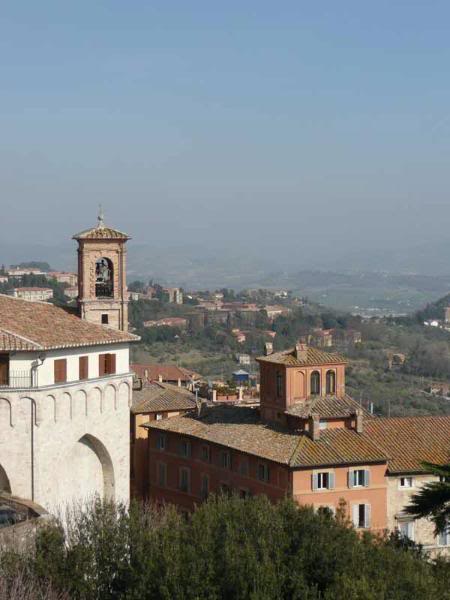
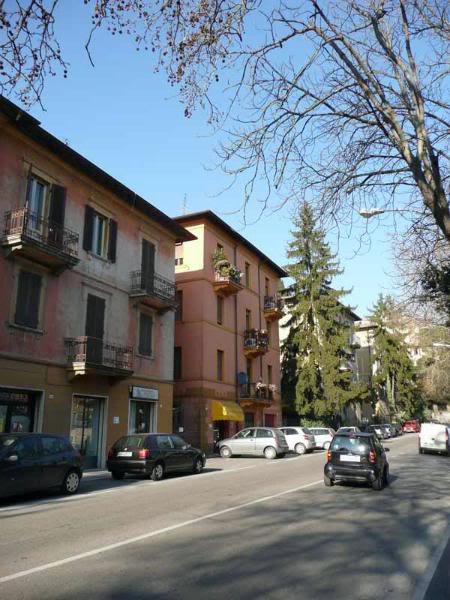
It's fresh bright weather and I feel lucky to be here, in this provincial town surrounded by people who are not on holiday but going about their everyday business. Being built on hills, Perugia has wonderful views from every open vantage point. I slip behind the post office, for example, and take photographs from the car park there. Normally you would see for miles but today there's a change-of-season haze in the valleys.
The weather forecast on Connie's TV was right. It's a blue sky, fluffy cloud morning with the promise of real sun to come. I'm up early, having breakfast in the Villa, where the upper floor is set out with the usual cereal and rolls, slivers of cheese and thin cut prosciutto and some very delicious pastries and cakes. A couple whom I've noticed in the dining room last night are already there and we have a chat. They're from Oslo and speak and understand some English. They're leaving to drive home this morning. The receptionist (a different, equally charming and beautiful young woman) gives me advice on exploring Perugia, and a map to guide me, and I set off towards the Centro Istorico, the old town district.
It's fresh bright weather and I feel lucky to be here, in this provincial town surrounded by people who are not on holiday but going about their everyday business. Being built on hills, Perugia has wonderful views from every open vantage point. I slip behind the post office, for example, and take photographs from the car park there. Normally you would see for miles but today there's a change-of-season haze in the valleys.
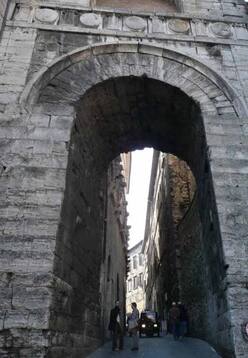
Arco Etrusco, Perugia
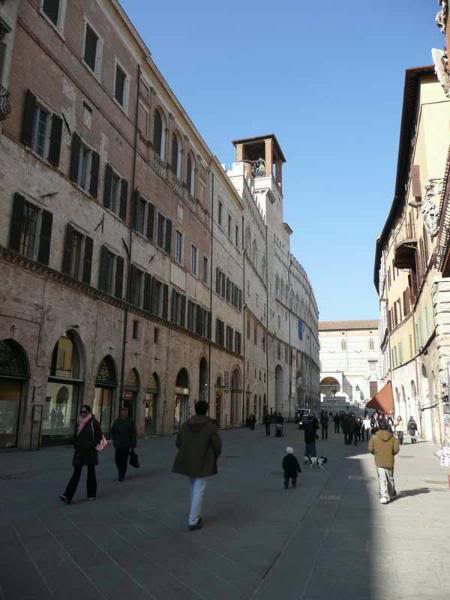
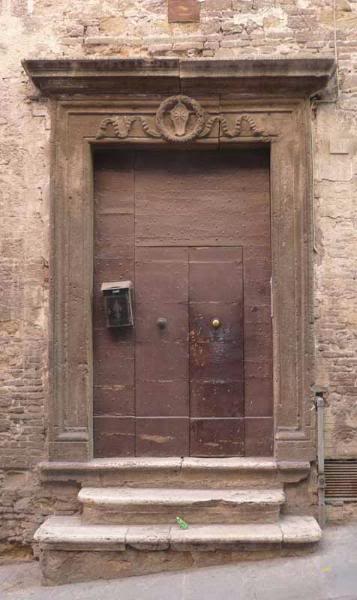
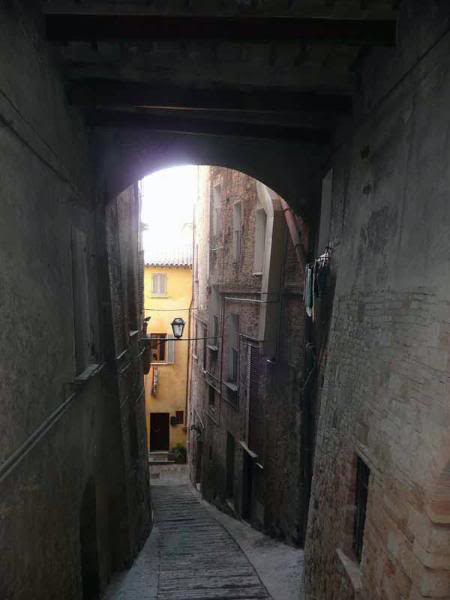
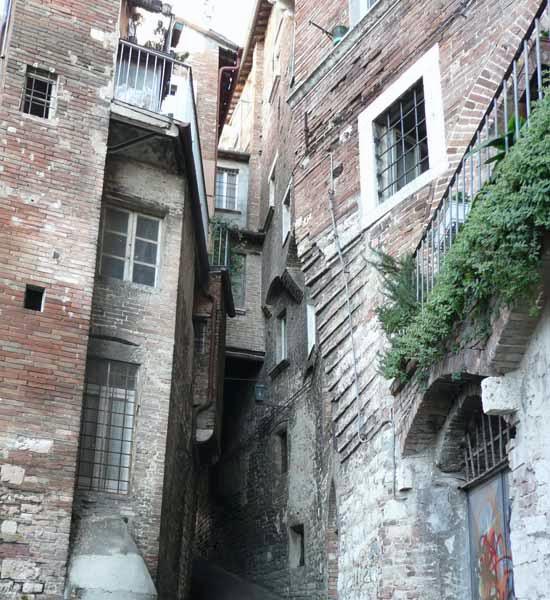
After five or ten minutes I reach an enormous archway. A narrow street leads further up the hill beyond it. This is the Arco Etrusco. There are sixteen gates into the city listed in the guidebook that I buy in a little shop just inside the archway. Perugia's history extends back to the Etruscan civilisation that came before the Romans. It's thought to have been founded in about 600 BC. The Romans took over in about 200 BC and after Julius Caesar's death the city became the centre of a quarrel between Octavian and Lucian Antony, two of the brothers of Mark Antony. It was besieged and burnt down in 40 BC and rebuilt by Octavian Augustus afterwards. It became a Christian centre early on, a bishopric in about 500 BC and was the focus of a lot of political intrigue and conflict up to 1000 AD. My guide book, written by Francesco Frederico Mancini and Giovanna Casagrande, gives a full account of the long and turbulent history of the town, right up to the present day. The streets that run between the Arco Etrusco and the main piazza of the city, Piazza Novembre IV, are very ancient. Via V. Rocchi is nicknamed "via Vecchia" ("the old street"). A parallel street, via Bartolo, was opened in 1378.
Perugia
|
|

|
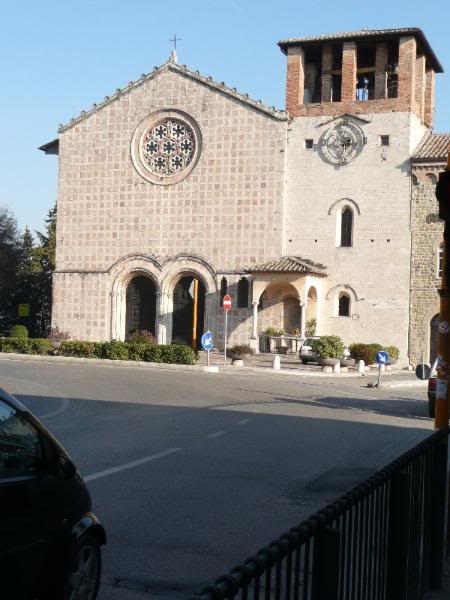
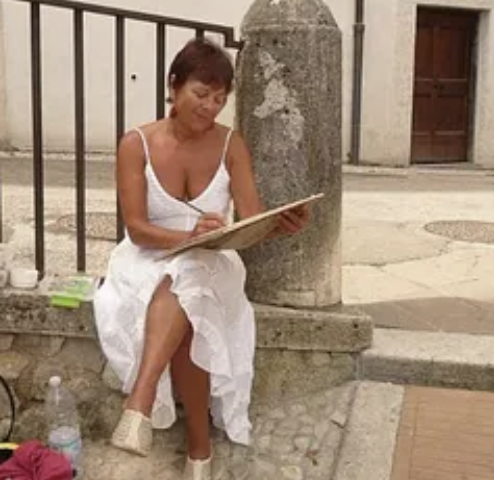
I was drawing the church in the photo above this picture.
|
|
|
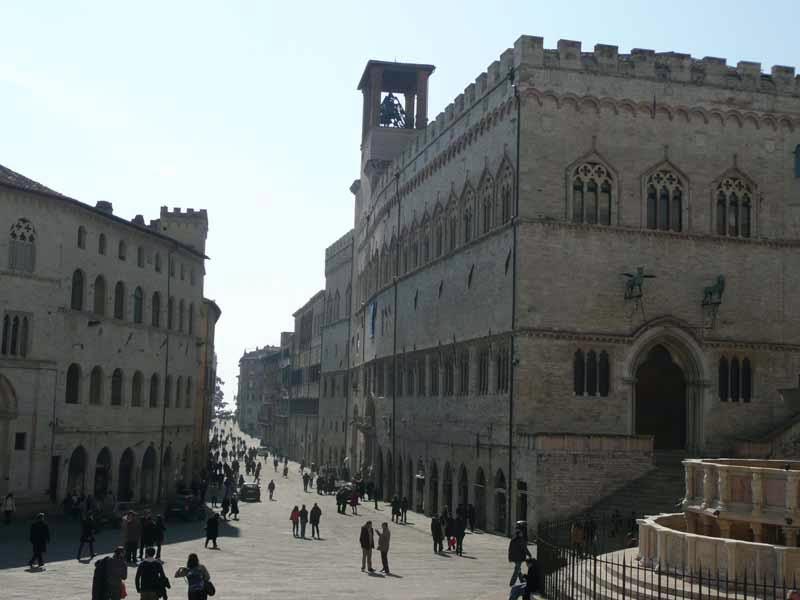
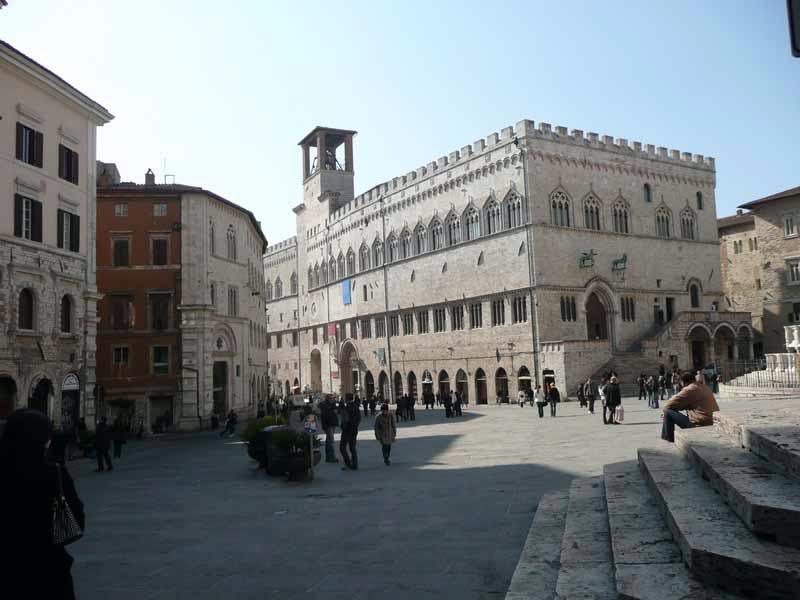
I come out of the shadows of the tall mediaeval palaces and into the wide space of the Piazza Novembre IV. The Great Fountain is not playing, but the sun is beginning to shine properly now and in contrast with the side streets there are a lot of people in the piazza. On the steps of S Lorenzo, the Duomo, sit dozens of students from the university, as well as sightseers like me. From the height of the steps you can see far off, down at the end of a wide thoroughfare past the Palazzo dei Priori, a hint of the distant view across the valley. People are scattered like ants in the piazza below me. As the light moves across the piazza and casts the castellated palazzo into shade, I sit on the steps and draw.
...........................................
April 2008 — Driving in Italy (2): Florence, Ravenna, Rimini, Tuscany, Umbria
7th April 2008 - TO FLORENCE
It’s one thirty in the morning of my first day in Florence. We are trying to lock the car. The car is a grey Renault Scenic that’s been wished on me by the hire car firm – I’m already planning to give it back as soon as possible. "We" is S and me. The car and I already have a history, before S came. For the first twenty minutes of our acquaintance it sat stubbornly refusing to give up the secrets of its operation. I managed to unlock the doors but the boot stayed impregnable. It was after eleven at night (the plane was 6 hours late). I hadn’t thought to look for a handbook – the Fiat Punto I hired in February had had none. I gave up and put my cases on the back seat. Next, found my way round the gears. OK. Now to start it. No key, just a card. I inserted it hopefully into a slot near the steering wheel. I was rewarded by an LCD dislay in Italian which included the word "Start". I pressed the button on the dashboard which also read "Start/Stop". Nothing happened. Timing is everything with this car. You can’t rush it. Finally it shuddered into life and I looked for the handbrake. In vain. There wasn’t one. This was a blow. How was I to make hill-starts? Hill-starts are my best subject when it comes to driving. I felt disempowered. But I edged out of the car-park and looked for the road to Porta Al Prato – eleven minutes away, according to the Internet information.
Now I realise the value of travelling with a companion. I need a navigator. I can’t read the directions and drive at the same time. And this is where my acquaintance with S begins. As I head back towards Forence, having driven some miles south down the autostrada in the wrong direction, S on his scooter draws alongside me while I pause indecisively at a junction on the almost empty A1. He’s observed my erratic progress down the highway and is in knight errant mode. I have so much to thank S for. Having established that (1) I am English and (2) I am alone and (3) I need to get to a hotel near the Porta Al Prato (he corrects my pronunciation carefully) he tells me to follow him and we set off, through a maze of streets. We draw up in the street next to the one where the hotel should be and start circling round the block on the one-way system, looking for it. We park and take stock of the situation.
S speaks no English at all and relates his circumstances to me at length in strongly accented Italian, with charming smiles and a gentle politeness on his thin face that I can’t resist admiring, leaning through the open passenger-side window. He is also living in a hotel, he tells me, because he has quarrelled with his brother and has had to leave the family home. He works, mostly in the leather industry. It’s a hard life but he seems philosophical. He does mention that he’d like to visit England. And now, here we are. We’ve found the hotel with difficulty – S has trundled my case up and down the street, insisting that it must be here, or there, or the other end – and we are, conversationally at least, almost on married terms – with S knowing best and me arguing (and in the end, both being right and both being wrong too).
Now we’ve found the hotel and parked in the street. We’re trying to lock the car. Every time we think we’ve done it, we try the handles of the doors to check, and find it unlocks itself again. This goes on for ten minutes. It’s 1.30 am at least. We leave the car apparently locked (we dare not try the doors) and find the hotel dark and closed. There is a notice, though, with a phone number for the night porter. S interprets it for me. I phone and the door is unlocked. S, behaving like a perfect gentleman, explains my circumstances and departs. The night receptionist is all smiles, despite being woken up at this unearthly hour. He helps me to find the car again (I have forgotten exactly where we abandoned it, temporarily – it’s been a long day, after all) and leads me into the secure parking area of the hotel. I sink thankfully into bed at about 2.30am.
It’s one thirty in the morning of my first day in Florence. We are trying to lock the car. The car is a grey Renault Scenic that’s been wished on me by the hire car firm – I’m already planning to give it back as soon as possible. "We" is S and me. The car and I already have a history, before S came. For the first twenty minutes of our acquaintance it sat stubbornly refusing to give up the secrets of its operation. I managed to unlock the doors but the boot stayed impregnable. It was after eleven at night (the plane was 6 hours late). I hadn’t thought to look for a handbook – the Fiat Punto I hired in February had had none. I gave up and put my cases on the back seat. Next, found my way round the gears. OK. Now to start it. No key, just a card. I inserted it hopefully into a slot near the steering wheel. I was rewarded by an LCD dislay in Italian which included the word "Start". I pressed the button on the dashboard which also read "Start/Stop". Nothing happened. Timing is everything with this car. You can’t rush it. Finally it shuddered into life and I looked for the handbrake. In vain. There wasn’t one. This was a blow. How was I to make hill-starts? Hill-starts are my best subject when it comes to driving. I felt disempowered. But I edged out of the car-park and looked for the road to Porta Al Prato – eleven minutes away, according to the Internet information.
Now I realise the value of travelling with a companion. I need a navigator. I can’t read the directions and drive at the same time. And this is where my acquaintance with S begins. As I head back towards Forence, having driven some miles south down the autostrada in the wrong direction, S on his scooter draws alongside me while I pause indecisively at a junction on the almost empty A1. He’s observed my erratic progress down the highway and is in knight errant mode. I have so much to thank S for. Having established that (1) I am English and (2) I am alone and (3) I need to get to a hotel near the Porta Al Prato (he corrects my pronunciation carefully) he tells me to follow him and we set off, through a maze of streets. We draw up in the street next to the one where the hotel should be and start circling round the block on the one-way system, looking for it. We park and take stock of the situation.
S speaks no English at all and relates his circumstances to me at length in strongly accented Italian, with charming smiles and a gentle politeness on his thin face that I can’t resist admiring, leaning through the open passenger-side window. He is also living in a hotel, he tells me, because he has quarrelled with his brother and has had to leave the family home. He works, mostly in the leather industry. It’s a hard life but he seems philosophical. He does mention that he’d like to visit England. And now, here we are. We’ve found the hotel with difficulty – S has trundled my case up and down the street, insisting that it must be here, or there, or the other end – and we are, conversationally at least, almost on married terms – with S knowing best and me arguing (and in the end, both being right and both being wrong too).
Now we’ve found the hotel and parked in the street. We’re trying to lock the car. Every time we think we’ve done it, we try the handles of the doors to check, and find it unlocks itself again. This goes on for ten minutes. It’s 1.30 am at least. We leave the car apparently locked (we dare not try the doors) and find the hotel dark and closed. There is a notice, though, with a phone number for the night porter. S interprets it for me. I phone and the door is unlocked. S, behaving like a perfect gentleman, explains my circumstances and departs. The night receptionist is all smiles, despite being woken up at this unearthly hour. He helps me to find the car again (I have forgotten exactly where we abandoned it, temporarily – it’s been a long day, after all) and leads me into the secure parking area of the hotel. I sink thankfully into bed at about 2.30am.
Florence 8th April 2008
|
|
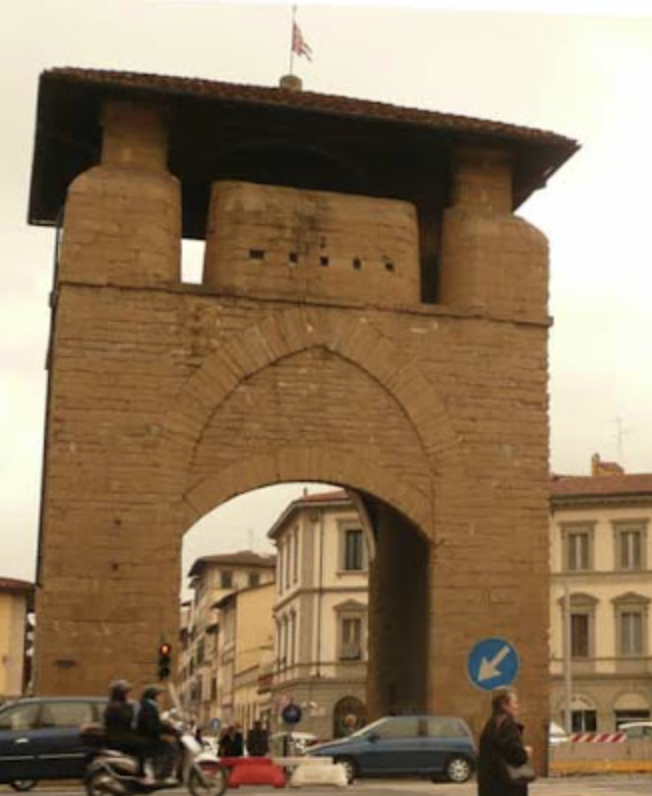
It should be raining today but the internet is wrong, at least for the morning. The first scooter comes past my window (three floors up but I might as well be under its wheels, it's so well defined) at 3.30. I've had about an hour's sleep. By 4.30 it sounds like a tank invasion outside, heavy vehicles trundling and roaring past – no hooting, though. This is not Naples. At 6.30 I give up pretending to sleep and get up. The apartment is great. Spacious and everything the agency promised. Except that it needs double-glazing. At 8.30 I sally down to reception to negotiate for a quieter room. The hotel is full and two single rooms are out of commission because of a water leak. I resign myself to either another short sleep period tonight, or spending more money on another hotel because this one will charge me for two nights regardless. I set off for the centre of Florence, a fifteen minute walk away, to visit the Duomo and other historic buildings that I last visited about ten years ago. There's a bus, number 17, the receptionist tells me, but I always walk if I can, because I more often come across things I'm not looking for then.
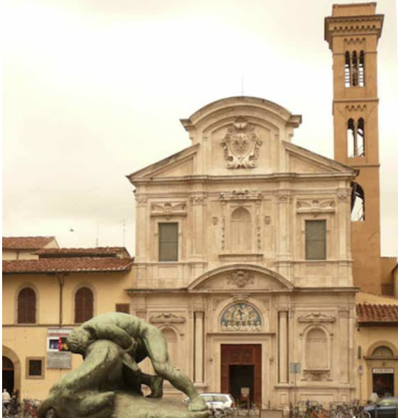
And so it turns out that as I take a turning down towards the Arno across a wide piazza I see a modern art exhibition of work by a Polynesian artist called Adi Da Samra, advertised on the wall of a Franciscan monastery, the Cenacolo di Ognossanti. I cross the square and investigate. Led into a cool arched cloister I find myself in the presence of a beautiful fresco that I've never appreciated before this moment. It's in a long vaulted hall, the refectory of the monastery, which was built in 1290.
And so it turns out that as I take a turning down towards the Arno across a wide piazza I see a modern art exhibition of work by a Polynesian artist called Adi Da Samra, advertised on the wall of a Franciscan monastery, the Cenacolo di Ognossanti. I cross the square and investigate. Led into a cool arched cloister I find myself in the presence of a beautiful fresco that I've never appreciated before this moment. It's in a long vaulted hall, the refectory of the monastery, which was built in 1290.
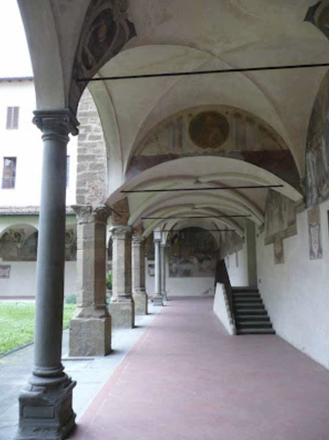
The modern art lines the two long walls leading up to Ghirlandaio's "Last Supper". Though the modern artist's work, hanging along the walls leading up to the fresco, is brilliantly coloured and meticulously constructed, Ghirlandaio holds his own down all the centuries since 1448 when he painted this fresco. It runs the full length of the short wall at the end of the hall. The monks ate their dinners in the presence of Christ and his apostles. I commit the faux-pas of allowing my camera to flash as I photograph it and am punished with what looks like the lifelong enmity of the guardian of the hall. She even objects when I sit down to draw it, briefly, until I am rescued by a pleasant colleague of hers who speaks (and probably is) perfect American. (Later the guardian relents when I am speaking for a long time to the curator of the modern artist's work, and she brings us both four leaved clovers from a plant she has discovered in the cloister.)
I want to draw the fresco because it's so perfectly situated in its context. Framed by simple, elegant arches of white stucco, it echoes, imitates, plays with the real space around and outside it. The light, the perspective, the composition of the figures as they celebrate the last meal with their friend and leader Jesus, are so moving when you are actually there with the picture. The mystery of perspective and tonal trompe l'oeuil is parallel with the religious mystery that surrounds the subject, it seems to me. Each of the figures has a distinct character, which I'm sure every observer has said before. And dominating the group is not Christ, but Judas Iscariot, the traitor, who sits as it were symbolically confronting Jesus from the other side of the table. His head is tilted up in interrogation and challenge, his beard pointing towards the leader's face. He is more in focus, more defined, than Jesus or any of the other disciples.
[Some 16 years later, transferring this blog to my2022 website, I've added this video clip showing the painting in detail...]
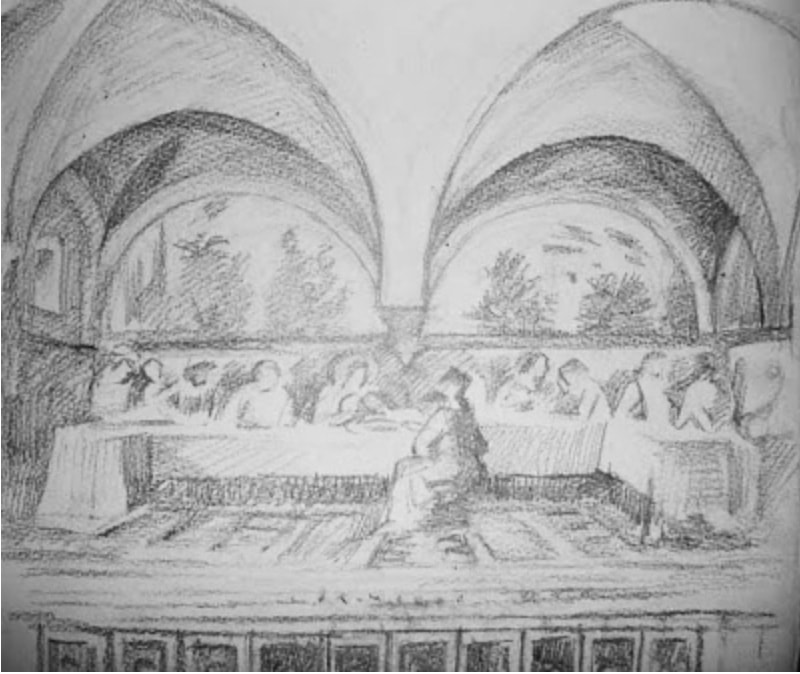
There is so much to say about this work, and I haven't time or space to write it now. I drew my sketch, which was even more difficult than I anticipated, then admired Adi Da Samra's art (genuinely because it really is stunning) and went out to continue my progress towards the Duomo. It started to rain, and I took this as my excuse for ducking into a little cafe and enjoying a really delicious plate of linguine, tomatoes and olives.
|
|
|
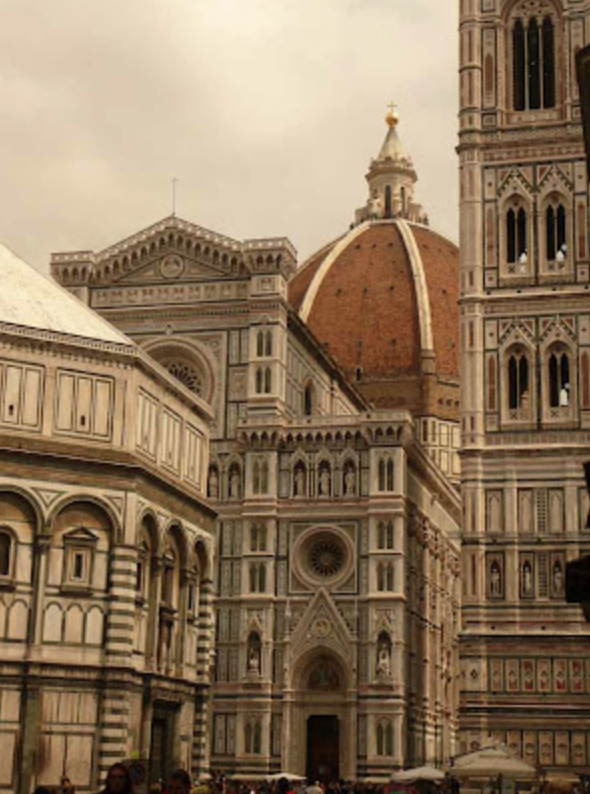
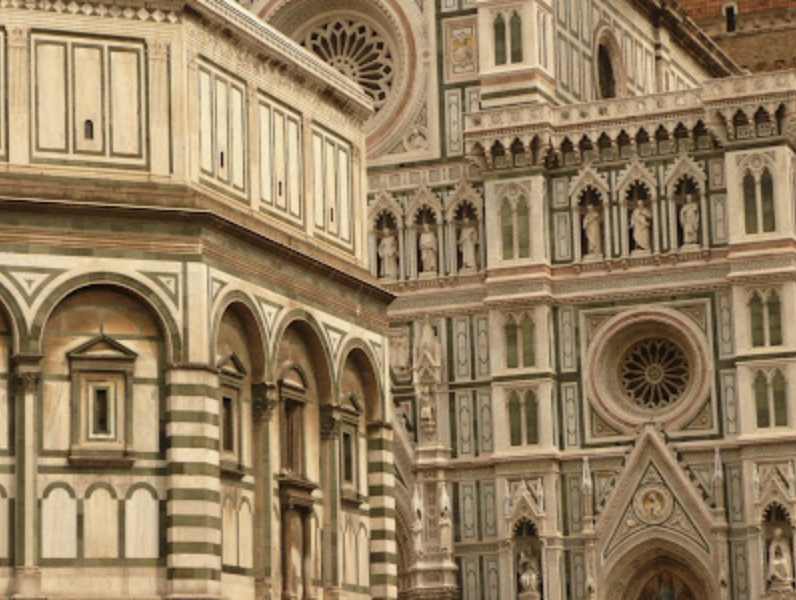
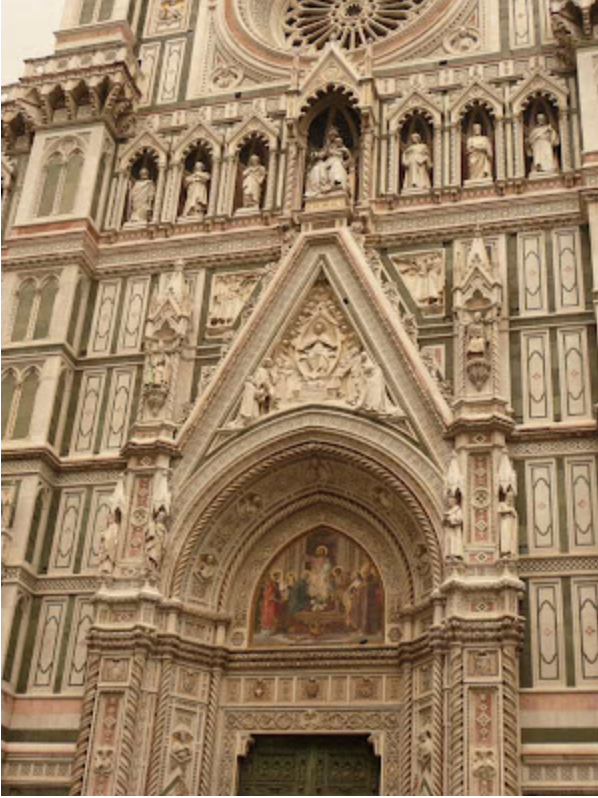
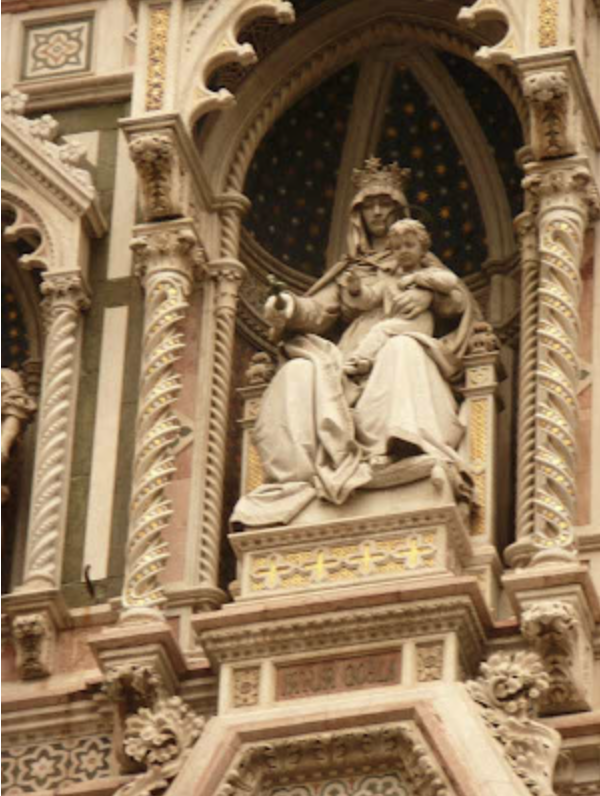
The Piazza del Duomo in Florence is an amazing place. I was last here ten years ago but still it takes me aback as I round the last corner on the narrow streets leading up to it. I shall post some of my photos here when I get home and you will see how rich the architecture is. But you have to be actually surrounded by all that black and white marble, all the sharply defined windows and gables and pilasters and towers, the barley sugar stick twists of the pillars at the huge doorway, the profusion of architectural geometric forms, the enormous rose window above the doorway and Brunelleschi's huge dome topping it off, with people like ants up there looking down from the gallery round the lantern - you have to be there to experience all the drama and richness of it.
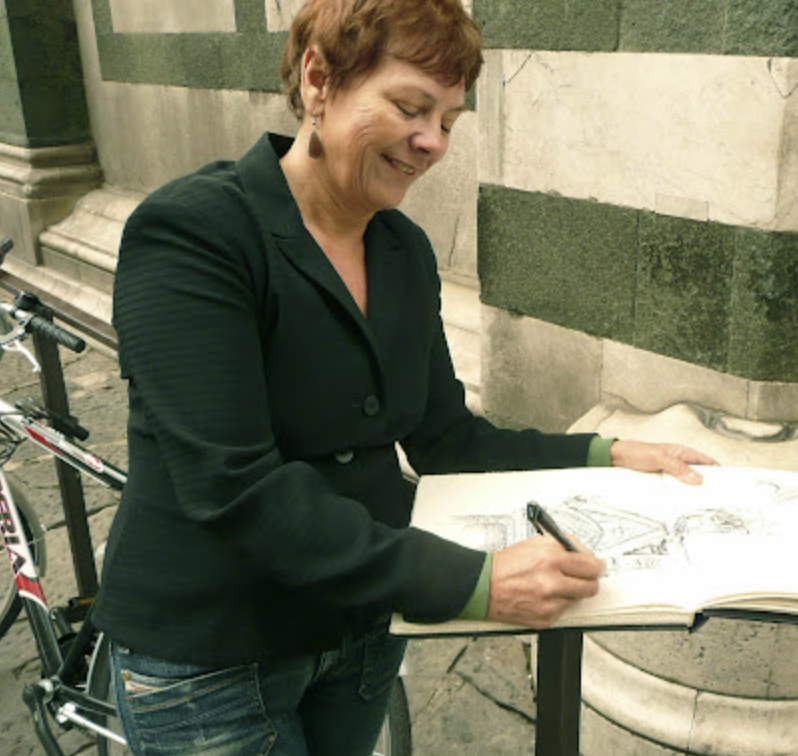
When I get there after lunch, the piazza is thronged with tourists, school parties and beggars. As the rain has stopped and there are queues to go inside the buildings, I decide to draw a sketch of the main entrance to the Duomo. There's nowhere to sit so I lean up against the railings round the Baptistry. As usual I've brought too small a sketchbook. My hand isn't very steady, the proportions go a little awry, but I'm soon engrossed and get the gist of it down on a double page. I'm seeing and understanding much more than my photos will give me, whatever the finished drawing is like. After about two hours the skies open and a serious rainstorm begins. My cue to duck into a bar for cappuccino and cake. I choose a seat overlooking an unusual, tilted view of the cathedral and start another drawing. The boy camerero (he looks like a painting of a naughty boy by Caravaggio but is probably about thirty) is chatting to four girls on the next table. He quickly knows their names, where they are from (Bari) and that they have lots in common with him. All five take an interest in my drawings. When I show them the sketch of the temple of Hera at Paestum the waiter tells us that this is where he lives. He keeps such a straight face that later I'm still wondering if he really comes from Paestum.
When I get there after lunch, the piazza is thronged with tourists, school parties and beggars. As the rain has stopped and there are queues to go inside the buildings, I decide to draw a sketch of the main entrance to the Duomo. There's nowhere to sit so I lean up against the railings round the Baptistry. As usual I've brought too small a sketchbook. My hand isn't very steady, the proportions go a little awry, but I'm soon engrossed and get the gist of it down on a double page. I'm seeing and understanding much more than my photos will give me, whatever the finished drawing is like. After about two hours the skies open and a serious rainstorm begins. My cue to duck into a bar for cappuccino and cake. I choose a seat overlooking an unusual, tilted view of the cathedral and start another drawing. The boy camerero (he looks like a painting of a naughty boy by Caravaggio but is probably about thirty) is chatting to four girls on the next table. He quickly knows their names, where they are from (Bari) and that they have lots in common with him. All five take an interest in my drawings. When I show them the sketch of the temple of Hera at Paestum the waiter tells us that this is where he lives. He keeps such a straight face that later I'm still wondering if he really comes from Paestum.
|
|
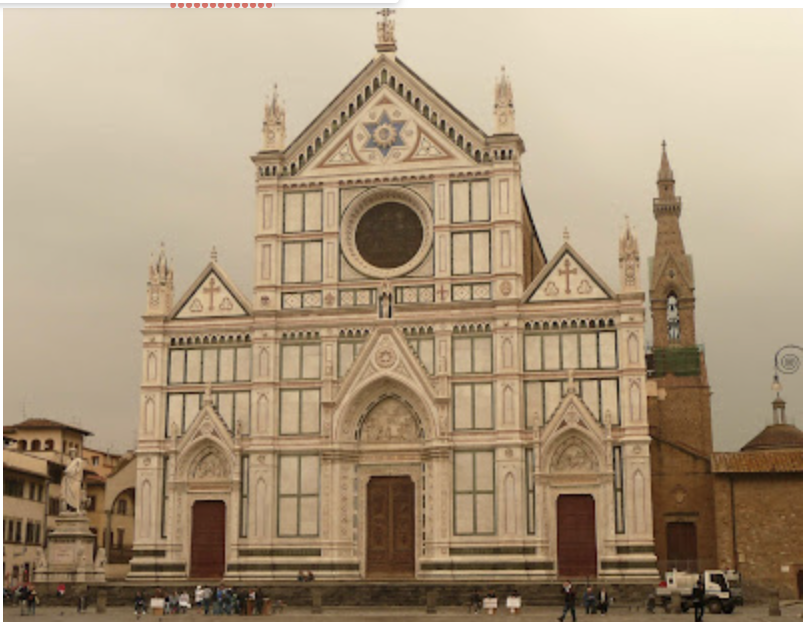
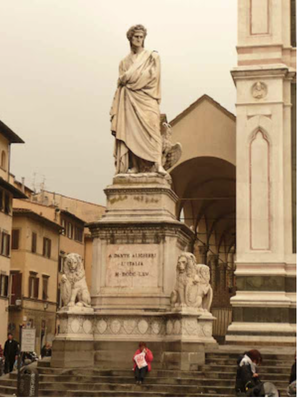
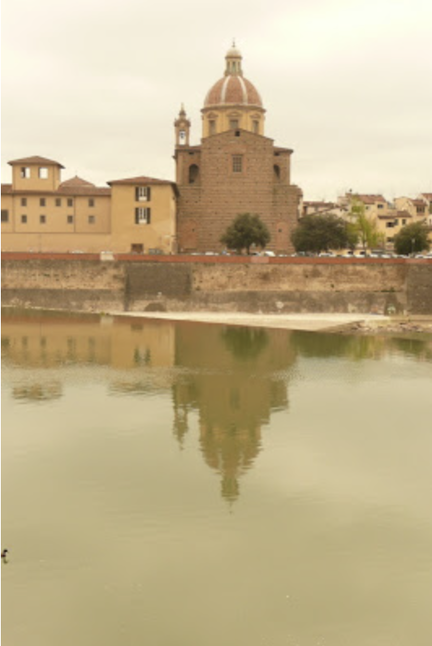
The weather's clearing again but it's getting late. I walk on, to the huge piazza of Santa Croce, where I've been told there's an internet point. I take more photos - the enormous facade of the church, the statue of Dante Alghieri who was born in Florence. Then I go on to the banks of the River Arno.
|
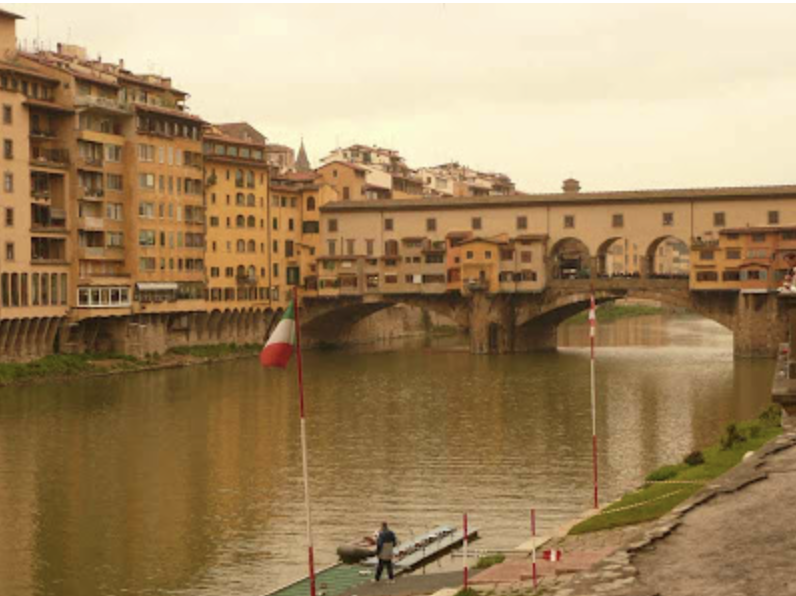
I can go across the Ponte Vecchia, with its gold and jewellery shops, to the Pitti Palace, or turn right and reach the Piazza della Signoria through the cloister of the Uffizi. I'm getting tired and dusk is falling, so I stay this side of the river and pass under the sombre windows of the dark grey Uffizi. There are still street traders on the steps, selling both originals and cheap prints (I bought one of each last time I was here). As usual, there's a chancer among them who tries to get himself invited for a drink with me, but it's all in fun and nobody loses face when I say "no".
|
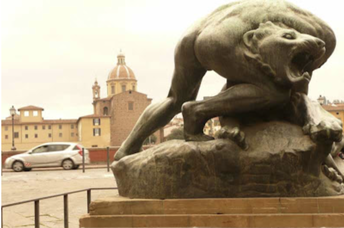
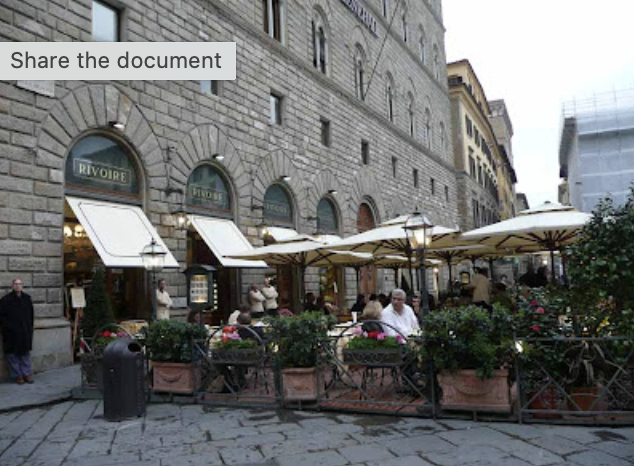
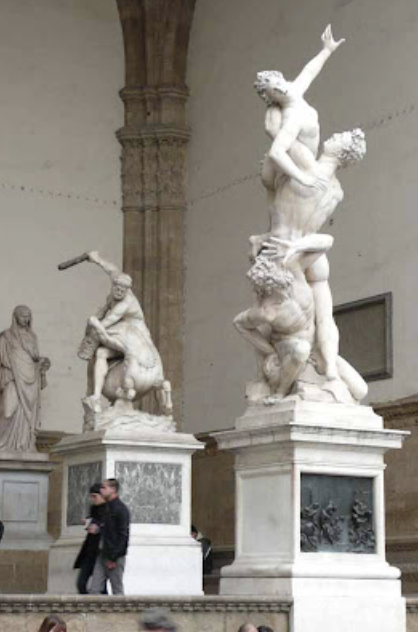
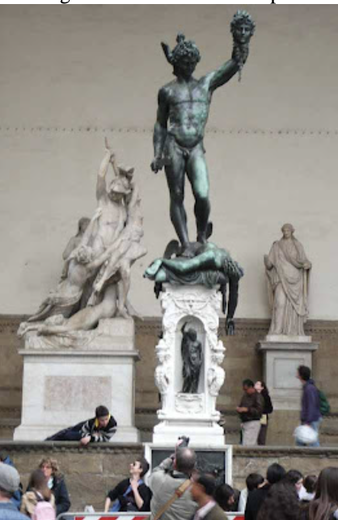
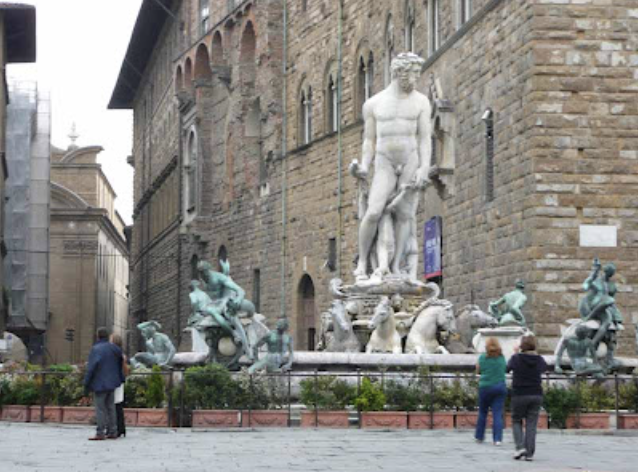
A small glass of wine at the bar facing Michelangelo's statue of David costs 6 euros but it does come with nice nibbles - almost sandwiches - and olives and crisps. I sit there for some time, drawing the arcade that houses a range of statuary, all on violent themes. There's a rape, at least one killing, and Cellini's young Perseus holding up the dripping, writhing head of Medusa. Lions prowl the foot of the pillars.
|
|
The Rape of the Sabine by Gianbologna is particularly beautiful - composed like a pas-de-deux by ballet dancers. The woman is hoisted up high on the shoulder of the attacker, while her husband lies vanquished under his feet. Later, after i've bought a guidebook, I find out that the sculptor's original title for this piece was "The Three Ages". The "Rape of the Sabine" does seem a more appropriate title. I make a separate study of the sculpture as I sit nibbling and sipping my wine. Dead on my feet, having survived the day on two or three hours' sleep and done five drawings, I fall into bed back at the hotel. I expect to be woken up again at 4am and I'm not surprised, this time, when what sounds like a convoy of tanks rolls through.
10th April 2008 - On the trail of St Apollinare
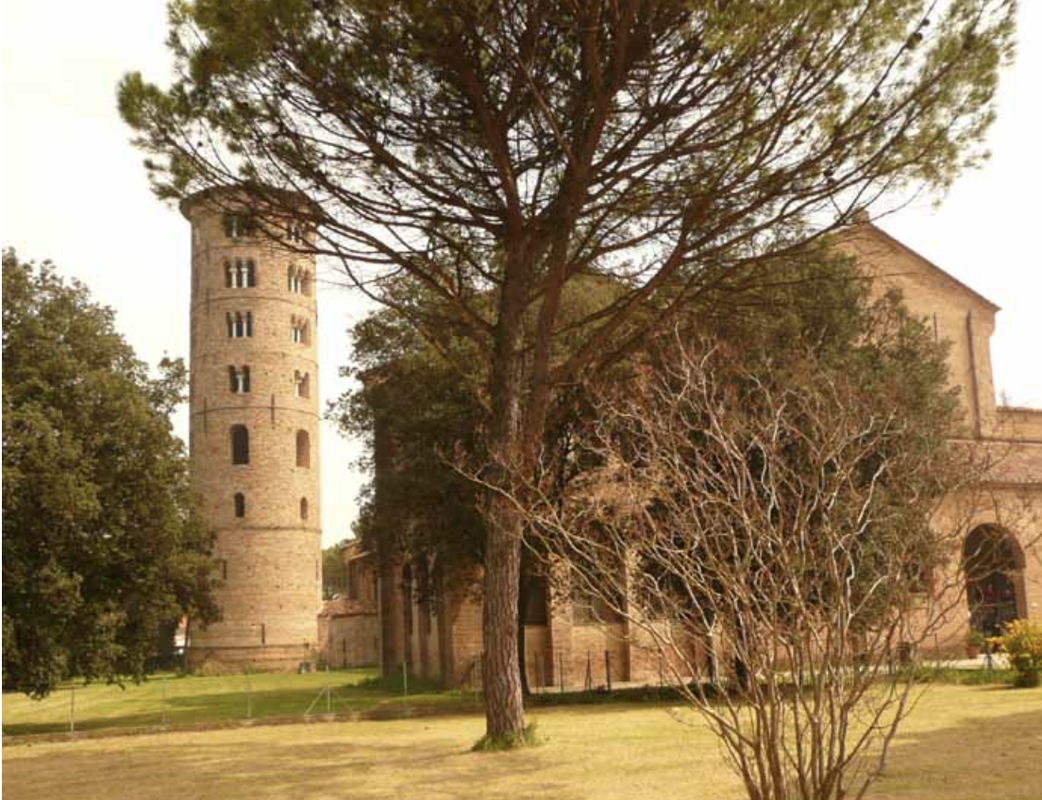
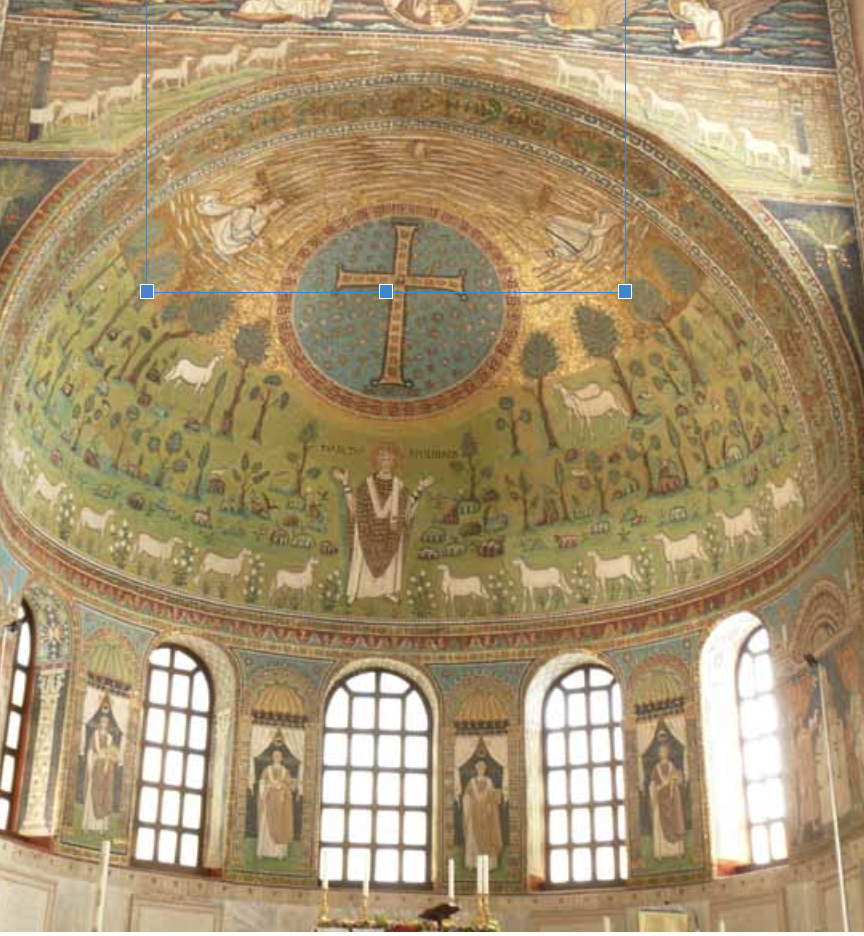
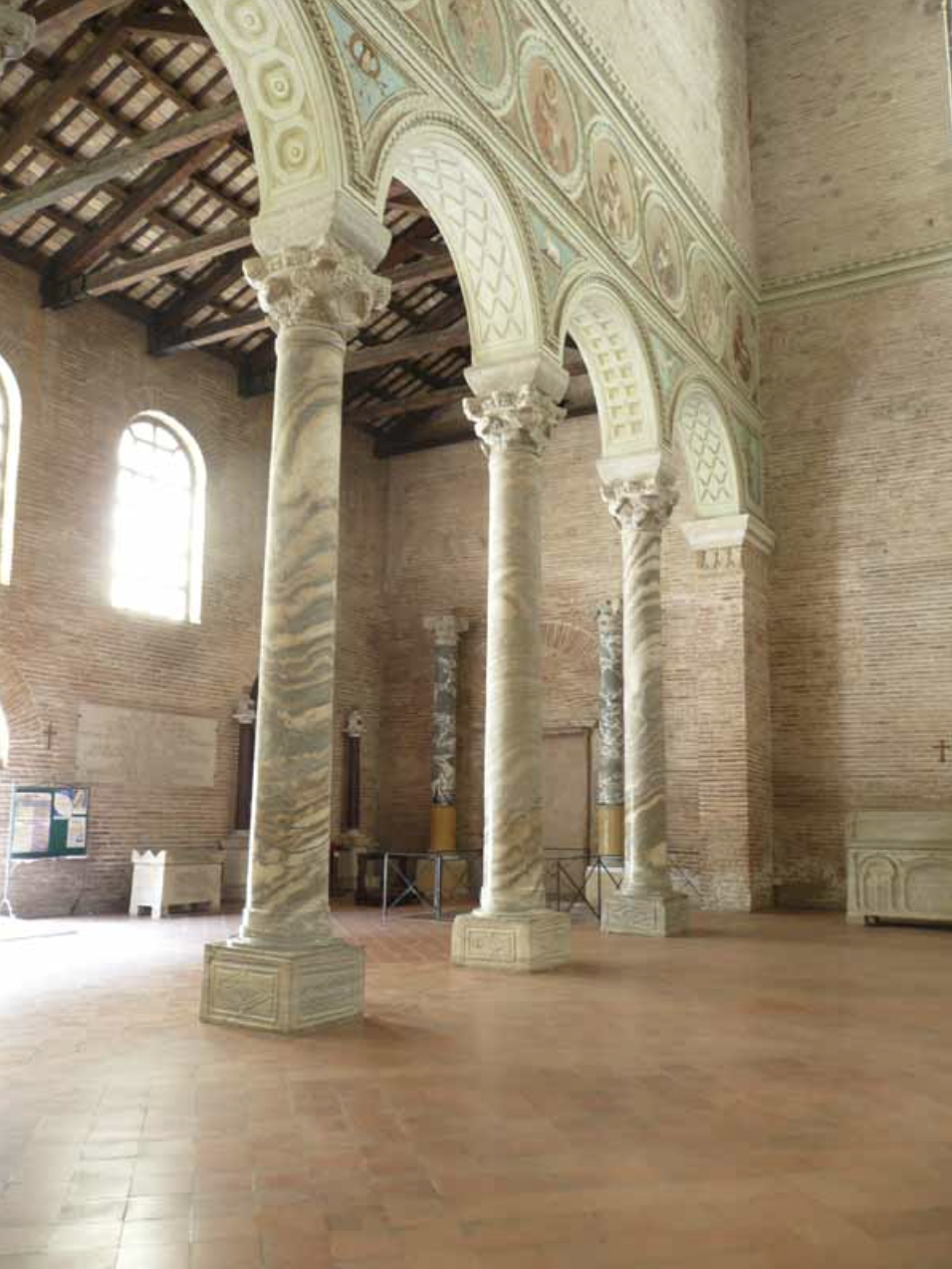
I went from Florence to Ravenna for a couple of nights and realised that what I had hoped would be an atmospheric, historic Byzantine town is now a huge sprawing industrial complex surrounded by all the infrastructure needed to support the port and the industrial estates that give it a livelihood. The reason I wanted to see Ravenna was that I wrote a thesis in my first year at art college about images of the Pantocrator (God the Father) in Byzantine and Romanesque art and I'd got all my illustrations from books and never seen a single relevant mosaic. One of the finest is in the basilica of St Apollinare, always said to be in Ravenna. So I booked my hotel right opposite St Apollinare, Ravenna, found the place with huge difficulty because like all Italian cities it has a labyrinthine one-way system, and went forth next morning to draw the mosaic. BUT I should have read my guide book - which I now did, and discovered that the original St Apollinare is in Classe, a bus-ride away.... I was staying next to the new church, which has only fragments of ancient mosaics on display, and none in its ceiling - in fact it has no cupola or apse big enough to house one.
So I got on the bus because I'd had enough of circling around in Ravenna in the car the day before. It all worked out very well. I spent the afternoon drawing in the ancient basilica and as usual providing welcome distraction for the schoolchildren of all ages who were trying to avoid their history teachers' lectures.
I went from Florence to Ravenna for a couple of nights and realised that what I had hoped would be an atmospheric, historic Byzantine town is now a huge sprawing industrial complex surrounded by all the infrastructure needed to support the port and the industrial estates that give it a livelihood. The reason I wanted to see Ravenna was that I wrote a thesis in my first year at art college about images of the Pantocrator (God the Father) in Byzantine and Romanesque art and I'd got all my illustrations from books and never seen a single relevant mosaic. One of the finest is in the basilica of St Apollinare, always said to be in Ravenna. So I booked my hotel right opposite St Apollinare, Ravenna, found the place with huge difficulty because like all Italian cities it has a labyrinthine one-way system, and went forth next morning to draw the mosaic. BUT I should have read my guide book - which I now did, and discovered that the original St Apollinare is in Classe, a bus-ride away.... I was staying next to the new church, which has only fragments of ancient mosaics on display, and none in its ceiling - in fact it has no cupola or apse big enough to house one.
So I got on the bus because I'd had enough of circling around in Ravenna in the car the day before. It all worked out very well. I spent the afternoon drawing in the ancient basilica and as usual providing welcome distraction for the schoolchildren of all ages who were trying to avoid their history teachers' lectures.
|
|
Then I went back to the historic centre where my hotel lay and had a very pleasant look around the local area. I found the Piazza S. Francesco where there is a beautiful church which has a Roman pavement, underwater, in the crypt. For 0.5 euros in a slot you can switch the light on in the crypt and peep though a hole near the altar at the strange sight of goldfish swimming around in a few feet of water over the remains of the Roman floor, among the graceful pillars and arches of the vault below.
Coda: June 2024
Here my 2008 diary ends. The rest of it is somewhere in the ether, in a lost blog that I can no longer access — even its title now escapes me. In July 2008 I met Dónall, the man who has given me the rest of his life and all the love I need. We went back together to Praiano later in 2008 and again in 2010 when we stayed in La Tranquilitá, now a beautiful hotel. In 2010 I wrote my little verses illustrated with the ink and watercolouur drawings I did there, and reproduced them in hand-sewn books, began making home-printed stapled pamphlets of Dónall's poems and my own, and conceived the notion of becoming a publisher. Sixteen years later, we're Dempsey & Windle / Vole. Our publishing imprint, VOLE Books, was set up to celebrate the principle we've established for ourselves. It's an anagram of LOVE.